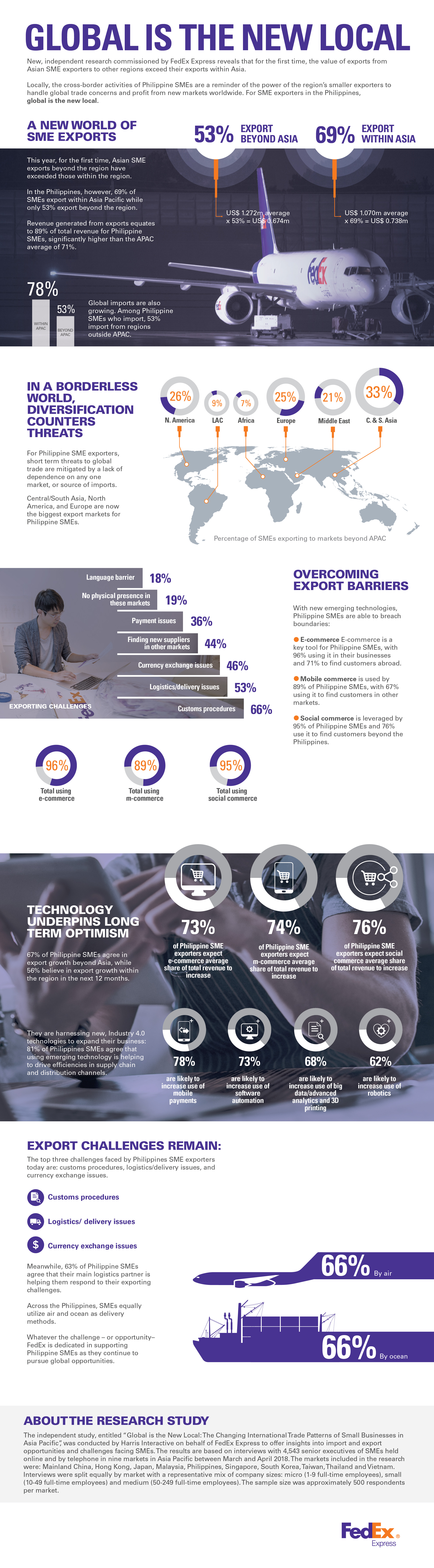
Ninety-six percent of Philippine small- and medium- size enterprises (SMEs) use e-commerce, which accounts for half (52%) of their total revenues, reveals FedEx Express’ research study, “Global is the New Local: The Changing International Trade Patterns of Small Businesses in Asia Pacific.”
The report shows that mobile commerce has high penetration among SMEs as well, with 89% using m-commerce to import goods and to find new customers. A significant 95% of SMEs use social platforms to reach new customers in other markets.
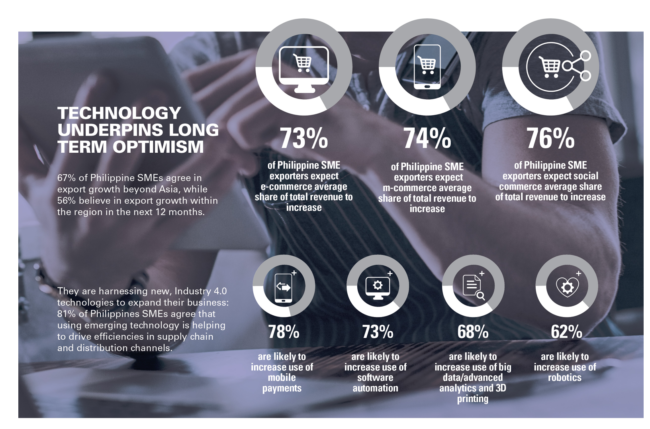
Additionally, Philippine SMEs are quickly adopting new technologies with 8 out of 10 saying they use both mobile payments and software automation to make their supply chains and distribution channels more efficient. These numbers are even higher than the APAC average which is 77% for software automation and 73% for mobile payments.
The report was conducted to study the cross-border activities of Philippine SMEs.
Export
The study commissioned by FedEx Express shows that exports account for 89% of Philippine SMEs’ total annual revenues with a combined value of US$1.4b, significantly higher than the APAC average of 71%.
The majority of local SMEs (69%) export within the APAC region and more than half (53%) export to other regions. Within APAC, China, Singapore, and Hong Kong are Philippines’ top customers.
Import
While 59% of the SMEs surveyed prefer to source items locally, Philippine SMEs also source raw materials and finished products from China, Japan, Singapore, and India.
Though Philippine SMEs are posting robust trade numbers, they continue to face two challenges: customs procedures (66%) and logistics issues (53%) in both exports and imports.
“We see the global trade footprint of Philippine SMEs is moving further afield as they start to think bigger in this thriving digital economy,” said John Peterson, managing director of FedEx Express Philippines. “Two out of three local SMEs say they will continue or even increase their export activities beyond the APAC region within the next year. We are pleased to see that more SMEs are growing their business beyond Asia Pacific with an increasing need for more sophisticated logistics solutions.”