















































































Hexagon’s Safety, Infrastructure & Geospatial division and Fujitsu Limited today announced the joint development of digital twin applications for predicting and mitigating natural disasters and traffic accidents. The solutions reflect the two companies’ ongoing efforts to realize resilient, disaster-resistant cities based on a business alliance formed in June 2022.
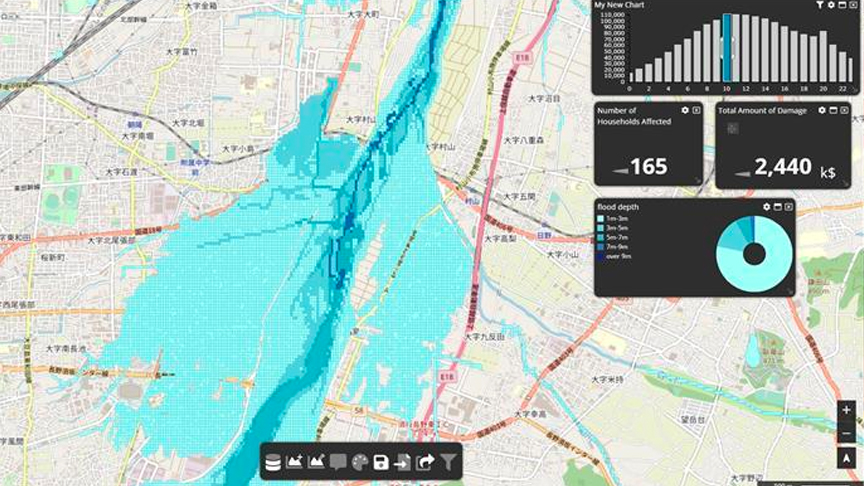
To support disaster mitigation, the two companies are developing a prediction model that calculates the extent and impact of flooding from precipitation data, visualizes the extent of flooding and performs damage prediction analysis. Based on the analysis, cities can develop disaster response plans.
To support traffic safety, the companies have focused on an application that identifies areas where heavy traffic and road design heighten the risk of accidents and proposes measures for improvement. The application would allow city planners and road administrators to develop safer, more resilient transportation networks.
Going forward, Fujitsu and Hexagon will continue conducting field trials with customers in the administrative, municipal and transportation sectors to support decision making for urban environmental optimization, with an aim to develop solutions globally by the end of fiscal 2023 ending March 2024.
Use case 1: Protecting cities and regions from natural disasters

(Example) Visualization of disaster situations by advanced flood forecasting

(Example) Reporting the number of disaster-stricken facilities and people and proposing countermeasures
Coordinating and visualizing data across multiple areas, including medicine, transportation, energy and the environment is vital to protect people and social infrastructure from the various threats posed by natural disasters and other dangers in an increasingly unpredictable world. Leveraging Fujitsu’s Computing as a Service (CaaS) platform, which offers users a powerful suite of easy-to-use services based on Fujitsu’s advanced computing and software technologies, alongside Hexagon’s M.App Enterprise real-time geospatial application, the two companies will use ‘digital rehearsal’ technology (Note 1) to analyze and verify disaster threats and optimal disaster preparedness in advance on a digital twin that replicates real world conditions with incredible detail.
The combined solution uses flood forecasting models and precipitation data to perform sophisticated calculations and visualize flooding, as well as to address challenges and use cases in the medical, financial, public and distribution industries, such as infrastructure damage forecasting, formulation of disaster response plans and estimation of damage amounts. In addition, it aims to secure safe evacuation routes and support infrastructure protection in the event of abnormal weather and natural disasters by leveraging weather IoT sensors and weather forecast services that monitor temperature and rainfall.
Use case 2: Contributing to the reduction of traffic accidents

(Example)Visualization and analysis of traffic accident data
According to a 2022 study report compiled by the World Health Organization (WHO), 50 million people are seriously injured and 1.35 million die annually from traffic accidents. Many accidents are caused by excessive speed, improper road guidance or the road environment. To reduce such accidents, it is important to visualize where accidents frequently occur, analyze the causes of accidents and propose solutions.
Through a combination of Hexagon’s geospatial visualization tool M. App Enterprise and Fujitsu’s infrastructure services, the companies have developed an application that visualizes areas with high levels of traffic accidents; analyzes traffic volumes, road design, signs and other factors; and provides recommendations for reducing traffic accidents in accordance with the Road Safety Toolkit (Note 2) of the International Road Assessment Program (iRAP).
For example, in a spot where traffic volume is low but accidents frequently occur, several improvement measures, such as speed control, installation of warning signs and separation of traffic routes between pedestrians and vehicles by guardrails, are presented together for a cost effective solution. These proposals for city planners, road administrators, local governments and consulting services contribute to the reduction of traffic accidents and the creation of safe and secure communities.
Mladen Stojic, president of government, transportation, defense and security for Hexagon’s Safety, Infrastructure & Geospatial division, said the partnership with Fujitsu continues to pay dividends for cities. “Hexagon is proud to work with Fujitsu to provide cities with tools to take control of their futures,” said Stojic. “By monitoring and mitigating factors that have negative impacts on society, from pollution to traffic congestion to flooding, our partnership is helping to make urban areas more sustainable and liveable.”
Yoshinami Takahashi, SEVP, Head of Global Business Solutions of Fujitsu Limited said, “We are very pleased to report on the progress of our partnership with Hexagon, which represents a big step towards realizing Fujitsu’s Trusted Society for Fujitsu Uvance. This new global offering promotes “sustainability transformation,” combining the strengths of both companies to address many complex issues facing society that cannot be solved through existing means.”