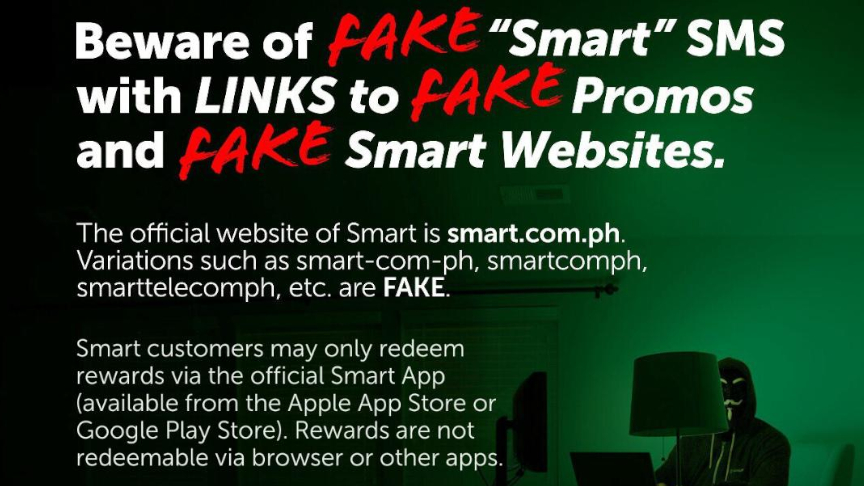
Smart Communications, Inc. warns customers to double-check links that are included in unsolicited SMS, even those supposedly coming from the network itself. Smart reminds its customers that its legitimate domain is https://www.smart.com.ph and any other iteration is fake. Smart also reiterates that its official domain ends with ‘.com.ph’.
“We remind our customers to carefully inspect URLs before opening them. Criminals often use spellings very close to legitimate domains to deceive customers into thinking they’re opening official websites,” said Cathy Yang, FVP and Group Head of Corporate Communications, PLDT and Smart.
Smart has recently denied owning the domain ‘smart-com-ph’ that was used in the fake ‘rewards’ text scam. Scammers used the fake domain to lead the victims to a fake site mimicking the Smart website, stealing the victims’ sensitive information. Smart has since blocked the phishing domain, along with similarly crafted domain names, from its network.
Additionally, Smart reminds customers that rewards points can only be redeemed via the Smart App. Smart likewise stresses that it will never ask for credit card information or require payment to redeem rewards points.
PLDT and Smart have boosted efforts to protect customers from scammers. In the first four months this year, PLDT Group has prevented more than 16 million SMShing messages from reaching customers. Smart also blacklisted more than 333,000 mobile numbers tied to scams and phishing activities from its network in the same period.
If you receive suspicious messages or calls, please report them to cybersecurityincidents@smart.com.ph or to our verified social media pages – Smart Communications on Facebook and @SmartCares on X – or call our hotline *888.