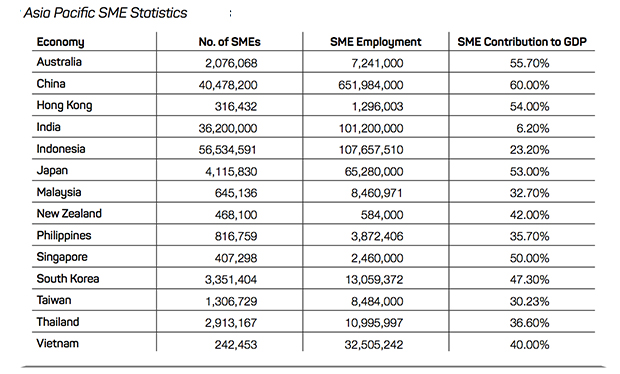
SINGAPORE – A long-accepted fact is that digital transformation isn’t just for big businesses, since small and medium enterprises (SMEs) can benefit from it too. This – without a doubt – is even more defined in Asia and the Pacific, where it is estimated that 98% of enterprises and over half of employment are provided by SMBs.

However – as was stressed at the 2016 NetEvents APAC Press and Analyst Summit – whether the “huge potential” of SMEs is being maximized remains questionable.
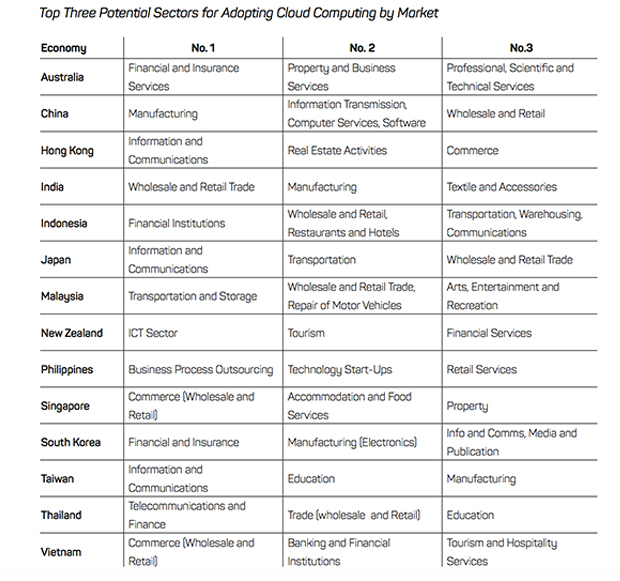
According to Camille Mendler, practice leader for SoHo and SME services of Ovum, big businesses may be at the forefront of cloud adoption, but “the real opportunity lies in transforming smaller businesses”, particularly since “a third of smaller firms are growing expenditure in mobile and cloud-related services.”
As per Ovum’s 2015 Telecoms Cloud Global Insights Survey, the big challenge remains informing SMEs about adapting technology for growth, considering that “more than a third of businesses actually openly expressed their digital illiteracy, which – in turn – is harming their business; this is also even more defined among the very smallest of firms.
But that “smaller enterprises are gaining attention” is in itself a good development, said Mendler, particularly since 38.5% of the customer segment that offers the best growth potential are the SMEs.
SMEs IN FOCUS
In SMEs in Asia Pacific: The Market for Cloud Computing 2015, Asia Cloud Computing Association noted that SMEs represent over 90% of all businesses across 14 countries in Asia, employing approximately 1.02 billion people and contributing around $10.9 trillion directly into the economies in which are based (49.1% of total GDP for the region.
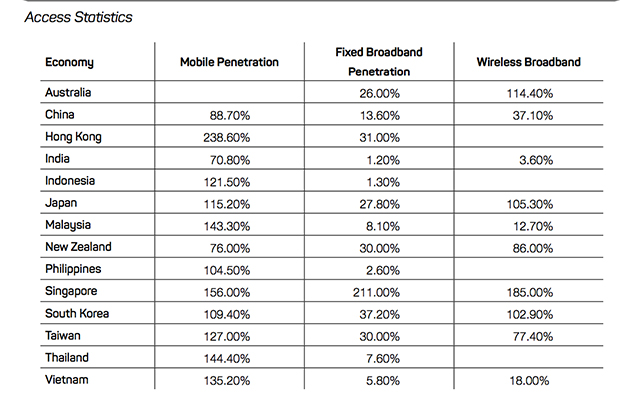
SMEs are also recognized to spend significantly on information and communications technology (ICT) even if majority of the ICT investment is still on traditional communications services, such as mobile voice, fixed-line and broadband. Obviously, growth was noted in expenditures in “cloud, virtualization, remote and applications services” – i.e. analysts estimated that SMEs spent about $2 billion on cloud services in APAC in 2014, with the growth rate for cloud services pegged at 42%.
However, “these statistics all appear to underrepresent and underplay both the opportunity and the impact of cloud computing services on the SME landscape across Asia,” noted Asia Cloud Computing Association.
IN FOCUS: PHILIPPINES
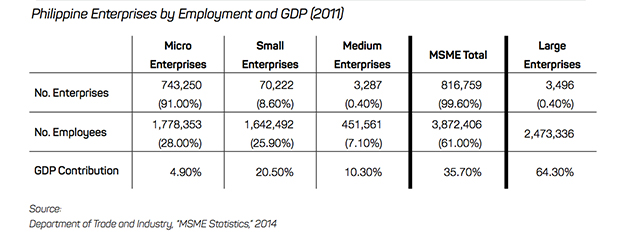
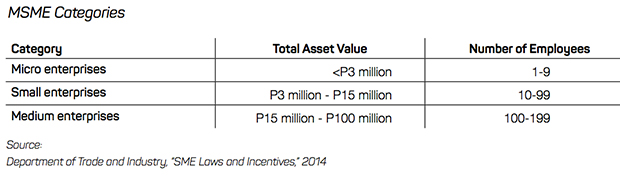
The Philippines is among the APAC countries where SMEs dominate. In 2011, 99.6% (or 816,759) of the country’s 820,255 business enterprises were classified as MSMEs, employing 3.87 million workers (compared to 2.47 million workers employed by large enterprises). The SME contribution to the country’s gross domestic product (GDP) for that year totaled 35.7%.
Helping SMEs adopt technologies has been a government strategy as early as 2008. In fact, even then, the intent was that by end-2016, the country’s SMEs should already: 1) have 90% Internet adoption; 2) 60% have websites; and 3) 30% use e-commerce.
Asia Cloud Computing Association noted Philippine-specific key characteristics vis-à-vis ICT adoption for SMEs.
First is the “limited budget for IT products and services” so that “they choose to spend most of their resources on sustaining their day-to-day operations, for salaries, basic utilities and rent”. If ICT-related investment happens at all, hardware accounts for the bulk of the spending (in 2014, this reached 76% of budgets). It is worth highlighting that “most local SMEs have minimal numbers of staff or completely no IT staff”, and “the owners are the ones responsible for choosing the IT products and services”.
Aside from reliance on word-of-mouth marketing, there’s also the preference for bundled services, so that telecom operators commonly offer “packages”.

HOW TO TAP SMEs
A look at the Philippines’ SMEs offers glimpses of the difficulties that are now also the challenges that many cloud service providers have to contend with if they attempt to profit by responding to SMEs.
“One of the things we found… is that there is the opportunity for SMEs to leapfrog from going from having no technology at all to get all the IT services (in cloud),” said Cisco’s Bernie Trudel.
The basic step that needs to be taken, of course, is to educate and create awareness on the good that cloud can deliver to SMEs.
As Asia Cloud Computing Association stressed in SMEs in Asia Pacific: The Market for Cloud Computing 2015, there is a need for “carefully created educational and awareness tools that effectively explain the value of cloud services to SMEs, including simplified comparisons of total cost of ownership; marketing descriptions of the business value; and simple guides to product features.”
But mere educating won’t be enough sans provision of support for implementation, since “a dedicated SME cloud implementation team (can) facilitate the implementation process of transitioning an SME to a cloud-based solution”.
Trudel added that, at least in Cisco’s case, solutions being offered run the gamut of needs, “from infrastructure to software.”
The bundling (a.k.a. packages) is also an approach that is proving effective in reaching SMEs. For instance, in the case of Wedge Networks – which offers cyber-security services – “we sell bundles; we well you broadband, for example, and also sell you security to ensure (safety when using broadband),” said Frank Wiener. But with this approach, basically, “you could pick and choose what you need.”
While it is true that “cloud computing – and cloud computing technology – has the potential to be the ‘great leveller’ for both SMEs and developing economies,” borrowing the words of Asia Cloud Computing Association, Ovum’s Mendler is first to admit the “late inclusion of SMEs in cloud talks”, with the focus given more to big enterprises.
But this is expected to change soon as cloud service providers finally – finally! – see that they can gain much from also helping SMEs gain.