




















































































Kaspersky has launched a report on tech-enabled abuse based on its global study*, which reveals that 45.7% of respondents experienced at least one form of tech-enabled abuse in the past 12 months — yet only 32% of people correctly understand what the term means. The report also includes an analysis of dark web offerings related to stalking services and shares key insights into the evolving landscape of stalkerware, with over 34,000 users affected by this threat in 2024-2025.
Tech-enabled abuse, also known as technology-facilitated abuse, refers to abusive behavior carried out or amplified through digital technologies such as smartphones, social media, or online platforms. It includes a wide spectrum of actions — from online harassment and exclusion to cyberstalking, impersonation, and unauthorized monitoring.
Because these behaviors often lack physical evidence and are embedded in daily communication, many users fail to recognize them as abuse. As a result, harmful actions may be normalized or overlooked.
The awareness gap highlighted in Kaspersky’s report underscores the importance of initiatives such as the international Tech Abuse Conference, hosted by UCL’s Gender and Tech Research Lab, where Kaspersky is contributing practical expertise through a dedicated Anti-Stalkerware Workshop.
“Technology-enabled abuse is still not widely recognised as a distinct category of harm, in part because there is no shared understanding of what it includes, which this study vividly highlights. This lack of clarity means many experiences go unnamed, unreported, and unsupported. Without a common framework, it remains difficult to measure the scale of the problem or respond to it effectively”, says Dr Leonie Maria Tanczer, Associate Professor at UCL Computer Science and Head of the Department’s Gender and Tech Research Lab.
According to the global study by Kaspersky internal market research center, 32% of respondents said that they knew what “technology-facilitated abuse” means. At the same time, 45.7% of respondents said they had experienced at least one form of tech-facilitated abuse in the past 12 months. The gap between these two figures — a third who are familiar with the term, but nearly half who have experienced it — highlights an awareness gap, suggesting that many individuals may encounter forms of tech-facilitated abuse without recognizing them as such.
The study shows that tech-enabled abuse is not limited to isolated incidents. Among those who experienced it globally, individuals encountered an average of 2.7 different types of abusive behavior. The most common threat was being blocked and excluded in ways intended to cause harm (16.7%), while 15.1% face situations of receiving offensive or rude messages.
Respondents from countries such as the USA and India reported higher exposure to multiple forms of abuse, while in parts of Europe and Asia people were less likely to acknowledge such experiences.
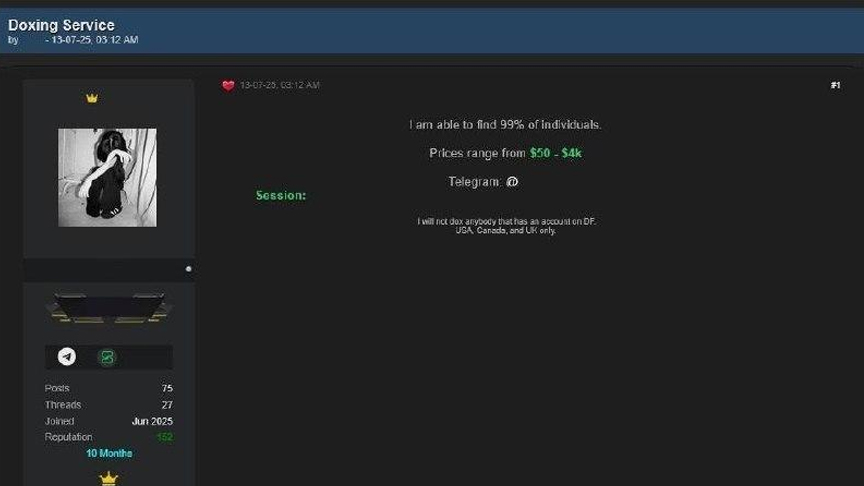
Kaspersky’s study also revealed that nearly 8.5% of respondents had experienced digital stalking, and 5.4% reported being doxxed. The risk of such tech-enabled abuse is also confirmed by the constantly evolving threat landscape. Kaspersky Digital Footprint Intelligence (DFI) experts identified a growing ecosystem of doxing services offered on dark web forums and costing anywhere from $50 to $4,000, as well as advanced surveillance tools capable of tracking individuals or extracting personal data – stalkerware.
Stalkerware refers to software programs, apps and devices that enable someone to secretly spy on another person’s private life via their mobile device. The abuser can remotely monitor the victim’s whole device including web searches, geolocation, text messages, photos, voice calls and much more.
Kaspersky continuously monitors the evolving landscape of stalkerware and related threats. According to the company’s data, in 2024–2025, more than 34,000 users were affected by stalkerware, bringing the total over the past five years to 127,000 users worldwide. During this period, Kaspersky identified 33 previously unseen stalkerware families, highlighting ongoing development activity in this space. Affected users were detected in over 160 countries, with Russia, Brazil, and India consistently ranking among the top three most affected countries in 2025, as in previous years.
“Stalkerware, which can be easily downloaded and installed by anyone with an internet connection, allows perpetrators to remotely access a victim’s smartphone from anywhere. Since the software operates in the background without being visible, most victims remain completely unaware that their every move and action is being monitored. That’s why it is highly important to know how to identify such activity and what to do if users suspect stalking activity against them,” says Tatyana Shishkova, Lead Security Researcher, Acting Head of Research Center Americas & Europe at Kaspersky’s Global Research and Analysis Team (GReAT).
Read the full report at https://lp.kaspersky.com/global/tech-enabled-abuse-1.
Recognizing the growing risks posed by stalkerware and the need for a coordinated response to this form of abuse, Kaspersky is one of the co-founders of the Coalition Against Stalkerware an international working group against stalkerware and domestic violence that brings together private IT companies, NGOs, research institutions, and law enforcement agencies working to combat cyberstalking and help victims of online abuse.
Recommendations for potential victims of stalkerware:
-
Consider using trusted security tools to help detect potential threats. For example, Kaspersky’s Who’s Spying on Me feature (available in Android apps) can identify stalkerware, suspicious apps with monitoring capabilities, and even unknown Bluetooth devices that may be used for offline tracking. Such tools can alert you to software that may be secretly accessing sensitive data, including your location, messages, call history, browsing activity, or keystrokes.
-
Do not immediately remove suspected stalkerware, this may alert the perpetrator and escalate danger. First assess your situation and contact a support organization.
-
Use a safe device (one you trust is unmonitored) to contact support services, search for resources, or communicate about your situation.
-
Look for warning signs: unusually fast battery drain, unexplained data usage, newly installed apps you do not recognize, or the “Unknown sources” setting being enabled.
-
Protect your accounts with strong, unique passwords. Change them on a device you know is clean.
-
Contact a domestic violence or stalkerware support organization for individualized guidance. Find your nearest via the Coalition Against Stalkerware website.




























