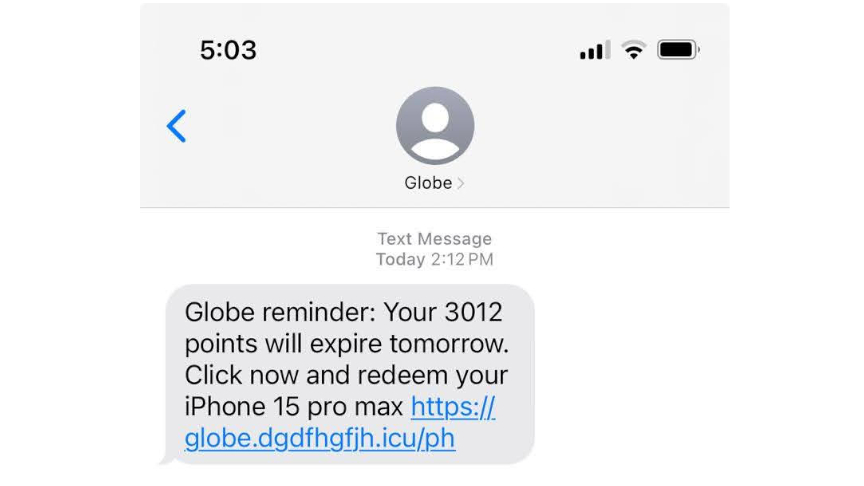
Globe has called on the public to be extra vigilant and never engage with text messages with links directing customers to click to redeem Globe Rewards, as these are scam SMS sent out by fraudsters via spoofing.
Customers have reported receiving spoofed messages impersonating Globe’s sender ID, inviting them to click dubious links supposedly to claim their Globe Rewards. These malicious links are meant to steal personal information, including credit card details.
Fraudsters are apparently taking advantage of Globe’s push for customers to claim their Rewards before the expiry on March 31, 2024.
All official SMS from Globe do not contain links.
“We call on our customers to please never click on links in SMS pretending to be from Globe. Any text message containing a link from supposed sender ID “Globe” is a fraudulent message done via spoofing. Globe will never send an official advisory with links. Do not fall for enticing offers in these scam messages,” said Darius Delgado, Globe Vice President and Head of Consumer Mobile Business.
He reminded customers that Globe Rewards may only be claimed via one platform: the GlobeOne app.
“Globe Rewards points may only be redeemed via the GlobeOne app. We’d like to encourage our customers to use this official platform, as this is the only place where they can claim rewards,” he said.
Spoofed messages are malicious SMS sent out via illegal equipment called the international mobile subscriber identity (IMSI) catcher or a fake cell tower or base station, which captures mobile users within a limited radius.
Brought around or foot or inside a vehicle, the IMSI catcher forces phones within a certain area to downgrade to 2G, the old cellular network technology for voice calls and texts. Fraudsters can then send out SMS from any spoofed or impersonated number or sender ID, such as “Globe,” to mobile phones connected to this fake cell tower.
These messages do not pass through the Globe network and go under the radar, evading its spam filters.
Globe observed a rise in spoofing and other forms of text scams, such as messages sent via over-the-top services or chat apps that are also outside the purview of telcos, after it bolstered security measures that filtered out spam and scam SMS.
In September 2022, Globe became the first Philippine telco to take the unprecedented step of barring all person-to-person messages with links from its network. It also implemented stronger policies on which sources or sender IDs are allowed to send app-to-person messages with links.
With its aggressive filters enforced 24/7, Globe blocked a total of 5.48 billion spam and scam messages in 2023, twice the volume it barred in 2022.
These measures altogether made SMS scamming more difficult for fraudsters, prompting them to find novel ways to do their illicit trade.
“As we continue to enhance our security measures to protect our customers and our network, scammers will keep finding new ways to defraud mobile users, which are often outside Globe’s control. We need the help of our customers to be proactive in protecting themselves as Globe does not have control over a lot of content that reaches them, such as texts from spoofed SMS and from chat apps, and unconfirmed information they get on social media. Please be discerning,” said Anton Bonifacio, Globe’s Chief Information Security Officer.
Globe calls on its customers to report suspicious SMS via its Stop Spam portal.
To learn more about Globe’s efforts against fraud, visit www.globe.com.ph.