With 25-billion devices that are expected to be connected to the Internet by the year 2020, the attack surface for hackers will exponentially increase. This, together with other challenges such as increasing attack sophistication, velocity and damage; increasing acceptance of public cloud by enterprises; increasing bandwidth; and legacy security strategies that are no longer enough, create security problems that organizations need to be concerned with.
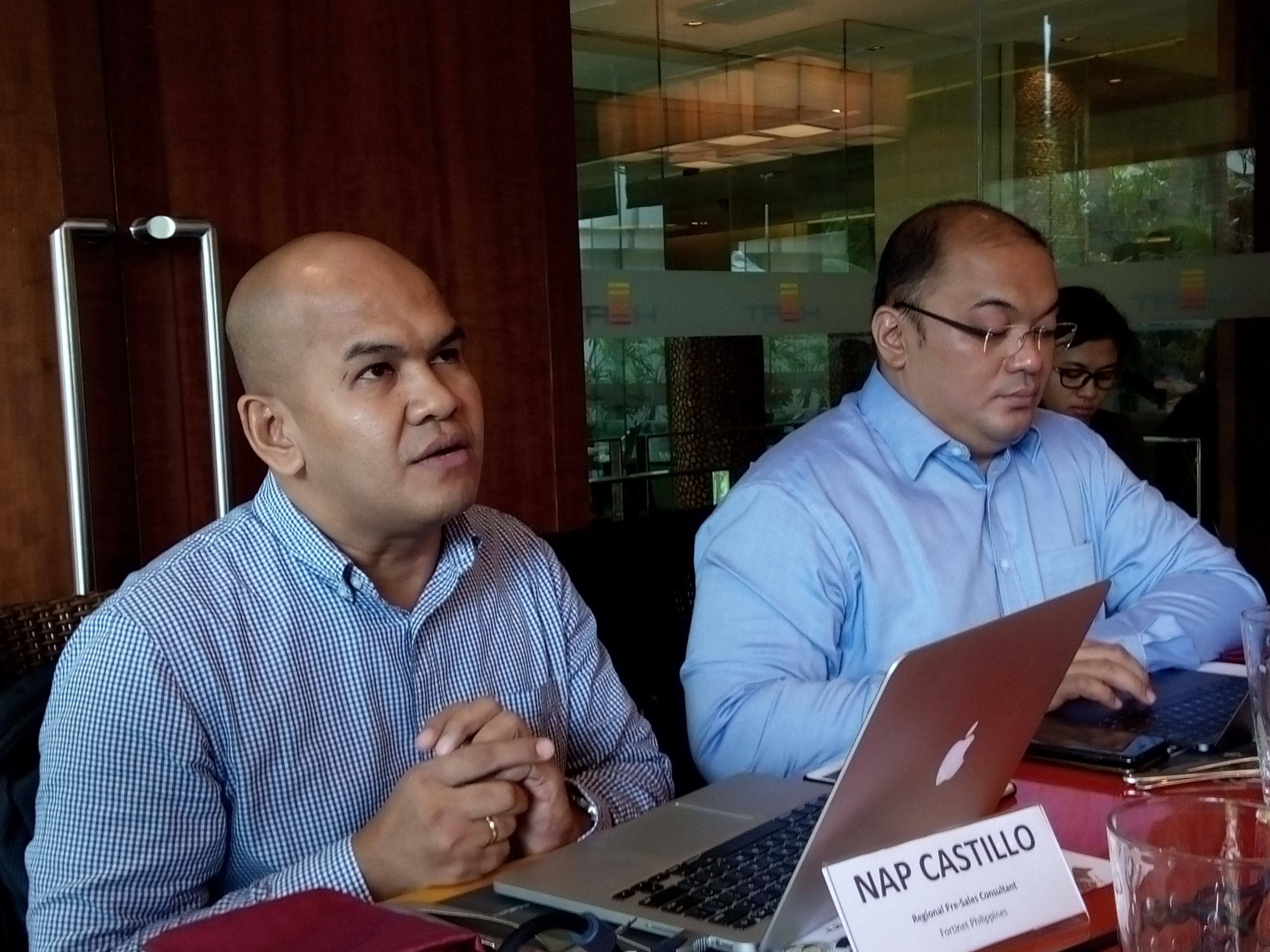
(From left) Nap Castillo, Regional Pre-Sales Consultant, Fortinet Philippines; Jeff Castillo, Country Manager, Fortinet Philippines
In a recent media roundtable, Nap Castillo, Regional Pre-Sales Consultant at Fortinet Philippines, discussed the factors that are affecting the security landscape and claimed that Fortinet is addressing these issues by embarking on an effort to integrate its security technologies and those of third-party security vendors to boost security across networks, and into the cloud.
This effort, called Fortinet Security Fabric, is an integrated, collaborative, and adaptive architecture designed to deliver distributed security for enterprises providing protections against threats from Internet of Things (IoT) and remote devices, through the infrastructure core, and into the cloud.
Castillo explained that Security Fabric functions more than a platform where it integrates network and security technologies into a single architecture, which is scalable to meet volume and performance demands; secure and open; provides awareness or security for different network up to the endpoint level, to the cloud and data center; and provides actionable threat intelligence.
He added that products of third-party security vendors can easily be integrated with Fortinet’s own security technologies through the opening up of APIs (application programmable interfaces) across the fabric so these solution providers can connect into it.
Fortinet works closely with its Global Alliance Partners, as well as the industry, to develop open APIs across the entire fabric, giving enterprises the flexibility to deploy Fortinet solutions alongside existing or new security technologies for integration protection.
Through this, Fortinet has partnered with Carbon Black, an endpoint protection provider, to provide customers with security automation, intelligence, and control through integration with the ATP framework.
With the new architecture, Fortinet has unveiled the FortiGate 6040E next-generation firewall which boasts 320Gbps of enterprise firewall throughput and 80Gbps throughput with all next-generation firewall features enabled; and intelligent networking, security, processing and management capabilities.
The firewall is available in six different interface configuration options tailored to match individual customer needs and with CP9 (content processor) that is four times faster than the current CP8.
Castillo said they already have over 100 installations of FortiGate 6040E firewall consisting of deployments in telecommunications, financial institutions, education, large enterprises and the government.
The FortiGate 6040E can be bought starting on the second quarter of the year while the FortiGate 7000 series will be available early third quarter of the year.
Castillo also announced enhancements on Fortinet’s Advanced Threat Protection (ATP) framework across several technologies. These enhancements include the following: FortiSandbox Advanced Threat Detection; FortiClient Endpoint Protection Software; Fortinet Enterprise Management System; and FortiMail Email Security Software and Appliances.