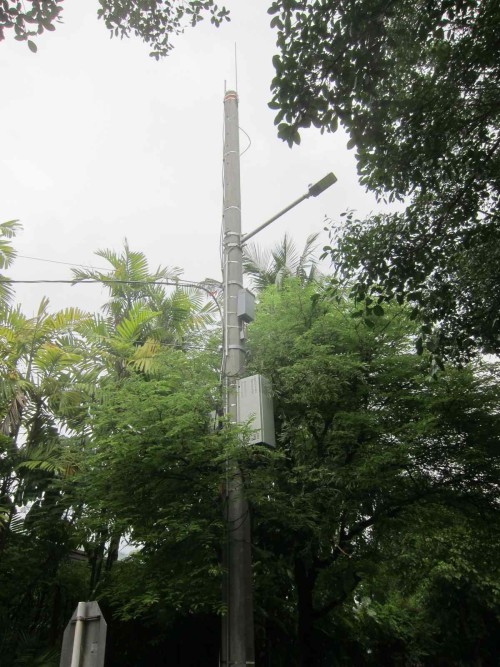
Globe Telecom cell sites have been issued radiation-safety certificates by the Department of Health, another indication that radio frequency signals coming from such facilities do not pose any adverse health impact.
“The radiation-safety certificates for every cell site that we have in the country are a proof that concerns over potential health hazard coming from base stations are without basis,” said Emmanuel Estrada, Globe Head of Network Technologies Strategy.
The radiation-safety certificates issued by the health department are based on guidelines issued by the International Commission on Non-Ionizing Radiation Protection (ICNIRP) and the Institute of Electrical and Electronics Engineers (IEEE) on maximum human exposures to radio frequency fields.
“Radio signals follow the so called ‘inverse-square law of physics’. This means that the signal level from a cell is radically reduced as the distance from the antenna increases. Thus the radiation at ground level is substantially lower compared to radiation levels emitted by the two-way radio of security personnel or a cell phone,” Estrada emphasized.
He also said latest technology provides a capability called “dynamic power control” wherein both the cell site base station and the subscribers handset dynamically reduce their power output to just about the right level necessary to provide service. This is effective in reducing radio frequency radiation levels as well as power consumption of the base station equipment in the cell site and saving battery life of handsets.
Surveys have also indicated that radio frequency exposures from base stations in publicly accessible areas, such as malls, schools and hospitals, are well within the international standards for radiation safety, he said.
By comparison, radio frequency exposures from base stations are a thousand times lower compared with radio frequency exposures to radio and television broadcast transmitters, he added, stressing that the strength of radio frequency fields is greatest at its source and diminishes quickly with distance because of the inverse-square law.
Radio frequency signals coming from cell sites are classified as non-ionizing. Other low frequency devices that emit non-ionizing radio signals include transistor radios, microwave ovens and baby monitors, two-way walkie-talkies. On the other hand, ionizing radiations are those that have higher risk of adverse health risks that include x-rays, ultraviolet rays, gamma rays, which can break the chemical bonds in DNA.