




















































































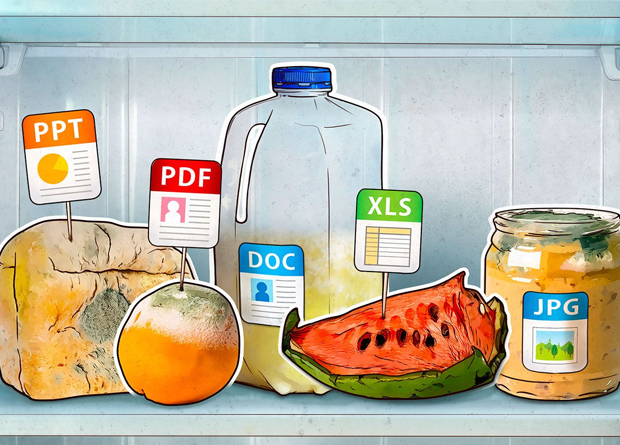
Businesses across the world are struggling to secure their data due to employees not recognizing their responsibility for digital clutter; the proliferation of digital documents and files without thought for managing the security consequences.
The global report “Sorting out digital clutter in business” from Kaspersky Lab found a number of correlations between the creation of digital clutter at work and human habits behind it, such as… organizing a fridge. It revealed that nine out of ten (95%) people who see their fridge as organized said the same about their working digital life.

Digital clutter includes the files, documents and data created at work without the business’ full visibility or control over how they are stored and who has access to them. It becomes a security risk when we consider that 72% of employees store documents at work that contain personally identifiable or sensitive data, which if exposed could either reputationally or financially damage a business, its employees and potentially its customers.

Tackling digital clutter is a challenge for businesses and one of the most important steps is understanding who is responsible for it. Nearly three quarters (71%) of employees believe either business leaders, the IT or security team should be responsible for ensuring emails, files and documents have the appropriate access rights, rather than themselves.
The problem is that while IT and security teams can control the access given to employees to access files and folders, there is room for human error. Whether accidentally or intentionally, for example, employees could give their colleagues or those outside the business access credentials or bypass IT administrators with new collaboration tools. With employees creating and collaborating on multiple documents simultaneously, they all must take responsibility for their actions causing digital clutter.

Source: ‘Sorting out digital clutter in business’, Figure 2
As the report showed, in employees’ everyday life there are habits that may correlate with the creation of digital clutter. As well as the majority of people who have similar habits with their fridge organization as they do their digital life, 88% of those who re-organize their fridge before a holiday, also do so for their work files.

“With data volumes increasing exponentially, business leaders should take notice of digital clutter and its potential security risk,” said Maxim Frolov, VP of Global Sales at Kaspersky Lab. “It is true that organizing your fridge won’t guarantee your defense against security breaches, but implementing the same mindset towards digital clutter will make you more resilient against cyber threats. Employees need to be educated on how to best manage their digital assets, and there should be simple but effective protection in place; one that does not add complexity but reduces it.”
To avoid becoming a victim of digital clutter, Kaspersky Lab urges businesses to consider:
- Getting employees trained up – it is very important that training teaches practical skills applicable to employees’ daily work such as with Kaspersky Automated Security Awareness Platform.
- Regularly reminding staff how important it is to follow cybersecurity rules to not to let cyber skills fade away, for example by hanging posters with advice around the office
- Making backups of essential data to ensure corporate information is safe and regularly updating IT equipment and applications to avoid unpatched vulnerabilities
- Finding a dedicated solution for small and medium businesses with simple management and proven protection features; such as Kaspersky Endpoint Security Cloud.




























