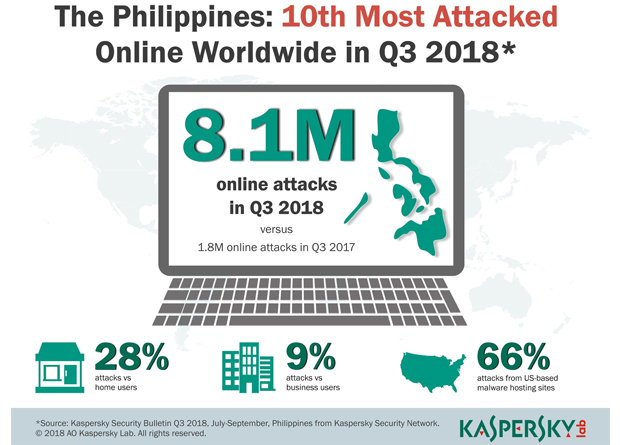
In three months, Kaspersky Lab monitored more than eight million web threats against Filipino Internet users. This places the Philippines as the 10th most attacked country worldwide in terms of online infections for the third quarter of 2018.
Data from the Kaspersky Security Network (KSN) revealed that over three-in-10 (33.3%) users in the Philippines were attacked by Internet-borne threats from July to September. Kaspersky Lab products have detected a total of 8,133,815 malware incidents on the computers of KSN participants in the country.
“While the latest threat statistics in the Philippines are relatively lower than last quarter at 10.6 million, eight million is still alarmingly a huge leap from last year’s numbers. In fact, we discovered just nearly two million online threats during the third quarter of 2017,” says Yeo Siang Tiong, General Manager at Kaspersky Lab Southeast Asia.
“In the same period last year, the Philippines ranked only 35th most attacked worldwide in terms of web threats.. The young and globally known Internet savvy Filipinos are fast becoming a prime target for the money hungry cybercriminals. It’s high time that they get their defenses up.”
Kaspersky Lab also discovered that online infections last quarter were detected on:
- 28.30% home users of Kaspersky Anti-virus, Kaspersky Internet Security, Kaspersky Total Security, and Kaspersky Free Anti-virus
- 9.08% business users of Kaspersky Enterprise Security
The main sources of these attacks were the United States (65.60%) followed by the Netherlands (12.31%), France (4.93%), the Philippines (3.95%), and Portugal (2.44%).
Web-based threats – or online threats – are malware programs that can target someone while using the Internet. These browser-based threats include a range of malicious software programs that are designed to infect victims’ computers.
Web threats include drive-by download that refers to the unintentional download of malicious code to one’s computer or mobile device leaving it open to a cyberattack. A drive-by download can take advantage of an app, operating system, or web browser that contains security flaws due to unsuccessful updates or lack of updates.
This infection can also be done through social engineering which involves tricking the human mind to download a legitimate-looking but infected program on a computer.
Internet-borne malware have been used to steal money and confidential data as well as to serve as launch pads for bigger attacks against large companies worldwide.
“These types of attacks can be avoided with a lot of common sense and vigilance. The lack of cyber-hygiene habits plays a very significant role in cybercriminals’ success. Filipinos need to be cautious with the sites they visit, files they share, apps they download, and the information they divulge online through social media platforms. Add-on a solution that holistically detects and blocks malware, and you will surely give these cybercriminals a hard time stealing your data and your money,” adds Yeo.
Similar to the global trend in web threats, most of the infections monitored against Philippine-based Internet users were malicious cryptominers.
Malicious cryptocurrency mining differs from legitimate mining only in that in the former, malefactors are using hardware that does not belong to them — they either infect computers or lure victims on mining websites.
The top five most attacked countries during Q3 2018 include Algeria (45%), Venezuela (40.7%), Belarus (40.5%), Albania (39.0%), and Moldova (37.9%).