Organizations fully utilizing cloud computing save on average more than 15% in IT spending, whether measured as a percentage of revenue or on a per-user basis. Savings come not only from a reduction in data center spending but also in IT personnel costs, according to a study by analyst firm Computer Economics.
Traditional vendors of IT products and services sometimes argue that systems deployed on-premises are more cost-effective over the long run than their cloud counterparts. They claim that while systems deployed on-premises may have higher acquisition costs, those costs are amortized over time in contrast to software as a service (SaaS) subscription fees, which continue for the life of the system in the form of recurring per-user fees.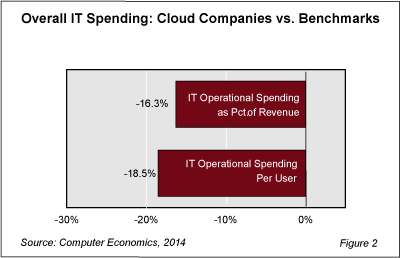
Cloud providers, on the other hand, argue that the up-front savings are significant, and that, in any event, the real benefits of SaaS are not in direct cost savings but in the flexibility, agility, and scalability cloud systems bring to the organization. Which side is correct? The answer is not an academic exercise. For organizations to make intelligent decisions regarding cloud systems, it is important to understand the relative costs of SaaS vs. on-premises systems and be able to answer the question, “Does SaaS save money?”
To answer this question, Computer Economics conducted a survey of seven organizations that have fully or largely migrated all of their systems to the cloud. The results are documented in the study, “The Economic and Strategic Benefits of Cloud Computing.”
The study finds that organizations fully utilizing cloud computing save on average more than 15% in IT spending, whether measured as a percentage of revenue or on a per-user basis. Savings come not only from a reduction in data center spending but also in IT personnel costs.
As a result of these economic efficiencies, cloud users are able to devote a higher percentage of their IT spending to new initiatives and less to ongoing support. The cost savings, combined with strategic benefits in speed, scalability, and agility, argue in favor of organizations moving aggressively to the cloud.
The seven cloud user organizations that participated in this study include two manufacturing companies, a life sciences organization, a wholesale distributor, a systems integrator, and an online content provider. They have annual revenues between $50 million and $550 million and between 135 and 860 employees.
The survey respondents use a variety of cloud providers, including Amazon, Autodesk, Box.com, Coupa, Docusign, Insperity (ExpensAble), FinancialForce, Google, Infor, Microsoft Dynamics, NetSuite, Okta, Paylocity, Plex, Rootstock, Salesforce.com, Saleslogix, Ultimate Software, Virtustream, Workday, and yieldEx.