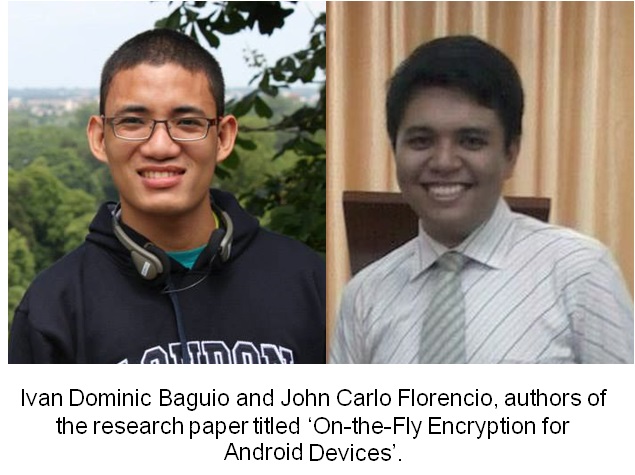
 Another Filipino made the country proud as 20-year-old Ivan Dominic Baguio wowed the panelists of the recently concluded Kaspersky Academy Cyber Security for the Next Generation Finals held last June 25-26 at the Royal Holloway, University of London.
Baguio is a college senior taking up Computer Science at the University of the Philippines (UP) in Diliman. He is a product of his hometown’s Cebu City National Science High School – one of the most prestigious secondary schools in the Visayas region.
At the London finals, Baguio was awarded for his presentation as the “Best Elevator Pitch” from among 14 finalists from 10 countries all over the world.
The citation was given to the Cebu native for his poised delivery of his presentation on the research paper entry which tackled the need for an on-the-fly encryption application for devices running on Android OS.
An on-the-fly encryption is a method that allows for easy access of files within a drive whenever and wherever one is.
Baguio represented the research paper in the competition, which he wrote together with thesis partner and classmate John Carlo Florencio.
“I thank all our students for their outstanding performances in this year’s conference,” said Jimmy Fong, Channel Sales Director at Kaspersky Lab South East Asia.
“For 2013, we’ve had very strong contenders for the top prize. At the regional cup, we had 9 out of 15 selected papers from South East Asia, a major feat! And for the finals, our region’s best two representatives got each for themselves major victories,” Fong said.
“Without a doubt, the quality of papers that has been coming from our region says so much about the students’ awareness on cybersecurity issues and the hard work they have put into it. I’m positive that these successes will inspire others that they, too, can come up with more innovative ideas that will make this world safe and protected from cyber criminals,” he said.
Prior to the international round of the contest, Baguio was among the 15 finalists in the Asia Pacific and Middle East and Africa (Asia-Pacific & MEA) Cup 2013 where he was named as “Best Speaker”.
The Kaspersky Academy Cyber Security for the Next Generation is an annual student conference on cybersecurity issues which aims to provide a collaborative environment where students, experts, scientists and researchers gather together to present and share their knowledge and ideas, inspiring them to push the limits of IT security technology still further.
In this event, students from all over the world are given the opportunity to present and discuss the most burning issues relating to global cybercrime.
The conference finals is the most exciting part of the competition where 14 finalists from 10 countries competed in the cybersecurity challenges to test their mettle.
“Reaching out to students across the world, challenging them and bringing out the best in them is what Kaspersky Academy’s Cyber Security for the Next Generation’ is all about,” said Nasir Memon, professor with the Department of Computer Science & Engineering and director of the Information Systems & Internet Security laboratory at the Polytechnic Institute of New York University.
“Companies don’t usually do this sort of thing,” he added.
“Getting involved with students is important for us all,” explained David Preston, head of marketing at Kaspersky Lab. “Collaboration between industry and academia is crucial – long may it continue.”
In this annual competition, the best research papers by undergraduate and post-graduate students are carefully evaluated by a panel of top global security professionals composed of Kaspersky Lab security experts and academicians from renowned institutes.
Among these entries, only three papers that show outstanding ideas are awarded the overall top prizes in the final round.
Though Philippines’ Baguio was not able to bring home the bacon, he impressed the judges with his clear and composed manner of presentation during one of the main events in the competition called “Dragon’s CyberDen Challenge”.
In this crucial part of the contest, students were asked to make an elevator pitch – a mere two minutes – to persuade the panelists to invest in their respective proposals.
According to Wikipedia, an elevator pitch is a short summary used to define a product or service and its value, in a time span between 30 seconds to two minutes – the approximate time for an elevator ride.
Given the challenge, Baguio did not only impress the judges with his research work but he was able to persuade them to “invest” in his proposal, winning the task overall.
In all rounds of the student conference, Kaspersky Lab sponsored the invited students’ travel expenses from airfare to accommodation and city tours.
It was the second time representatives from the Philippines were able to enter the grand finals.
The first was in 2012 where UP Diliman students Joshua Arvin Lat together with thesis group mates Rod Xavier Bondoc and Kevin Charles Atienza bagged the first place for their research paper which proposed a secure online USB-based login system to protect online accounts.
The Filipino team’s paper won first prize in the APAC and MEA Cup 2012 held in Hongkong and in the Conference Finals 2012 held in the Netherlands. The group received cash prizes for their wins.
Indonesian student Firman Azhari of Bandung Institute of Technology was declared overall winner of this year’s Kaspersky’s tilt for his study entitled “Detection of Security Vulnerability in Indonesian Near Field Communication (NFC) Applications”.
Application for the next year’s competition starts in October 2013. Updates are available from the Facebook page of the Kaspersky Academy.