




















































































The use of satellites, as opposed to terrestrial networks, has numerous benefits; and yet its adaptation in the Philippines remains low. This is according to Glen Tindall, VP for sales in Asia-Pacific of SES, one of the largest satellite operators by revenue in the world, owning/operating 55 telecommunications satellites that cover 99% of the world’s population; and Jose Del Rosario, research director at NSR Manila.
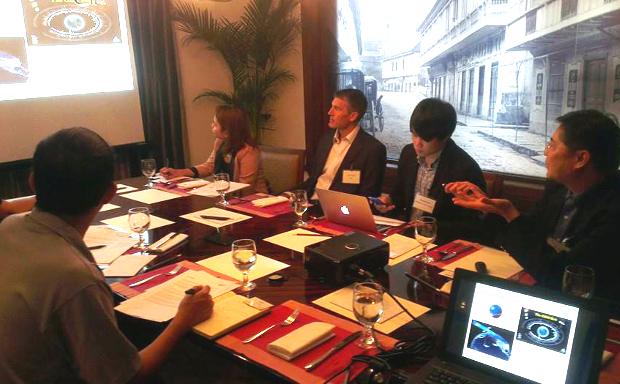
“If you are in an area where you can install fibers, good. But if it’s in a remote area, that is just unrealistic,” Jose Del Rosario said. In this case, “satellites make more sense.”
Terrestrial networks remain limited, said Tindall, since – among others – “it is not everywhere, and may not be secure.” This is why satellites are worth considering “because of their economic gains, productivity improvement, and leapfrogging mechanisms.”
Satellites, orbiting the Earth from 37,786 kilometers/22,223 miles at 11,300 km/hour or 7,000 mph, are “parked” at the equator, traveling in the same direction as the Earth. Because of this, a satellite has an ubiquitous coverage, so that “three satellites enable 100% global coverage,” Del Rosario said. Satellites, therefore, offer a more robust and reliable infrastructure, just as it can be used in emergency situations.
When supertyphoon Haiyan (local name: Yolanda) hit parts of Visayas, for instance, telecommunication infrastructures were similarly damaged. Modes of communication that made use of satellite technology helped connect those affected with the service providers.
As such, satellites can be “the only viable solution in underserved and in remote locations,” Del Rosario said.
As it is, in the Philippines, “usage us relatively low compared to other Southeast Asian countries,” Del Rosario said. Current uses include video distribution and DTH. But “there are future demands, such as HDTV, and the increase in pay TV.” Suffice it to say, if adaptation becomes pervasive, there are numerous beneficial impacts, including in enterprises and businesses, national security/military, disaster preparedness, and in addressing the ICT/digital divide.
“If you are in an area where you can install fibers, good. But if it’s in a remote area, that is just unrealistic,” Del Rosario said. In this case, “satellites make more sense.”
SES currently operates six satellites that provide coverge over Asia-Pacific. This year, the company will be launching the biggest SES satellite to serve the region: SES-9, which will provide incremental, as well as replacement capacity; and expand SES’s capabilities to provide DTH broadcasting and other communication services in Northeast Asia, South Asia and Indonesia, as well as maritime communications for vessels in the Indian Ocean. In the APAC region, SES transmits more than 1,000 DTH channels, over 90 of them in high definition; carries eight DTH platforms; and reaches over 41 million homes.























