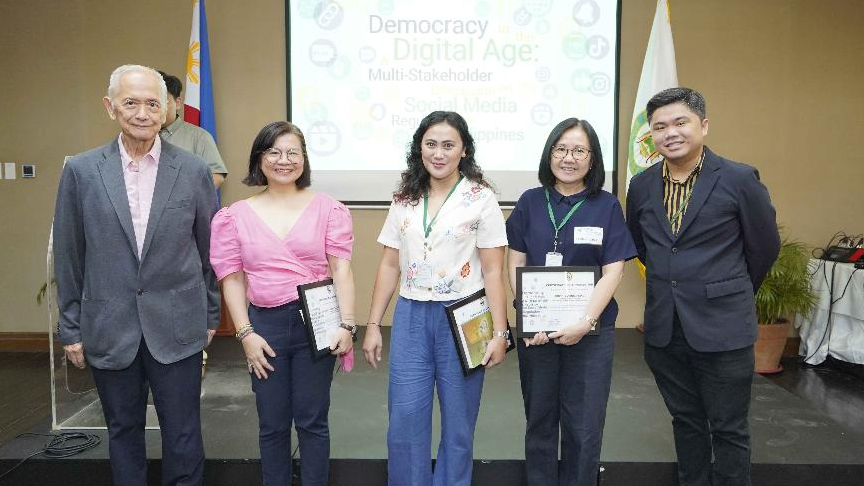
The FEU Public Policy Center Foundation, Inc. (FEU PPC) convened policymakers, industry leaders, civil society organizations, media practitioners, and academics for a multi-stakeholder forum on social media regulation and information integrity last May 2026 at Far Eastern University Manila.
Titled “Democracy in the Digital Age: A Multi-Stakeholder Discussion on Social Media Regulation in the Philippines,” the forum underscored a central message: addressing disinformation and regulating digital platforms requires shared responsibility, and no single solution, whether legal, technological, or behavioral, will be sufficient on its own.
Opening the discussion, FEU PPC Chairperson Dr. Edilberto C. De Jesus framed the challenge as one of balance, noting that “you’re trying to balance between two values, the protection of the rights of the public, but also the protection of journalists.” This tension, he emphasized, lies at the heart of ongoing debates on social media regulation.
From the legislative side, Representative Nathaniel “Nat” Oducado of 1TAHANAN Partylist highlighted the breadth of proposals currently being deliberated in Congress, covering areas such as disinformation, artificial intelligence, and platform regulation. He acknowledged the limits of legislation alone, stating that “Congress cannot catch up with what’s happening on the ground. This field cannot be regulated by law alone.” He emphasized that public participation and responsible digital behavior are equally critical, adding that “before clicking, sharing, or sending something, we must require every Filipino to first think.”
Providing a systems-level perspective, Ms. Kankan Ramos, lead author of FEU PPC’s discussion paper “Disrupting the Disorder,” emphasized that disinformation is embedded within a broader ecosystem shaped by platforms, incentives, and user behavior.
“Disinformation – it’s not just about content; it’s a system,” she said, underscoring that responses must move beyond isolated interventions. She stressed that “the challenge is not whether to regulate, but how to co-regulate,” calling for solutions that are collaborative, context-driven, and responsive to Philippine realities.
Reacting to the presentations, Atty. Mark Goriceta reinforced the need for a holistic approach, noting that “these are not purely legal problems, they are behavioral, cultural, and systemic ones. He cautioned that poorly designed laws may have unintended consequences, particularly when definitions are unclear, as “fake news is extraordinarily difficult to define, vague definitions invite selective enforcement.”
From a civil society perspective, Cristina Lopez of the Foundation for Media Alternatives highlighted the importance of rights-based and inclusive regulation. “The question is not simply whether we regulate disinformation, but how, for whom, and at what cost,” she said, emphasizing that policies must safeguard freedom of expression while addressing harm. She warned that regulatory approaches must be carefully designed to avoid being “weaponized to silence communities speaking truth to power.”
Meanwhile, journalist and UP Diliman lecturer Yvonne Chua emphasized the complexity of the issue, noting that “information disorder is not an easy subject to organize. It cuts across politics, journalism, education, law, public relations, advertising, culture, and everyday online behavior.” She underscored that addressing the problem requires understanding its systemic nature, involving “creators, audiences, platforms, incentives, and social conditions,” rather than treating it as isolated cases of harmful content.
Across sectors, participants converged on the need for a multi-stakeholder approach that brings together government, platforms, media, civil society, academia, and the public. Discussions highlighted that effective responses must combine legislation, platform design reforms, media and information literacy, and stronger institutional support systems.
As the Philippines continues to grapple with the challenges of disinformation and digital governance, the forum reinforced that there is no one-size-fits-all solution. Instead, meaningful progress will depend on sustained dialogue, shared accountability, and coordinated action across sectors.