
















































































PLDT Inc (PLDT) and its wireless unit Smart Communications, Inc (Smart) are urging industry stakeholders, including government agencies, local government units, tower companies and other telco operators, to intensify collaboration in order to address challenges that persist as the government continues to find ways to streamline permitting processes and fast-track the roll out of telco facilities.
At the fourth telco workshop led by the Anti-Red Tape Authority (ARTA), telco representatives also shared the positive impact of key Joint Memorandum Circulars and the Executive Order No. 32 issued last year by President Ferdinand Marcos Jr., which streamlined the permitting process for the construction, installation, repair, operation and maintenance of telecommunications and Internet infrastructure in the country, and its Implementing Rules and Regulations (IRR).
“EO 32 and its IRR signal a pivotal achievement, further boosting our efforts toward a more efficient, transparent and business-friendly environment,” said ARTA Secretary Ernesto V. Perez.
According to ARTA, there was a significant rise of 48% in approved telco-related permits between May 2022 and May 2024, underscoring the positive impact of EO 32 and its IRR.
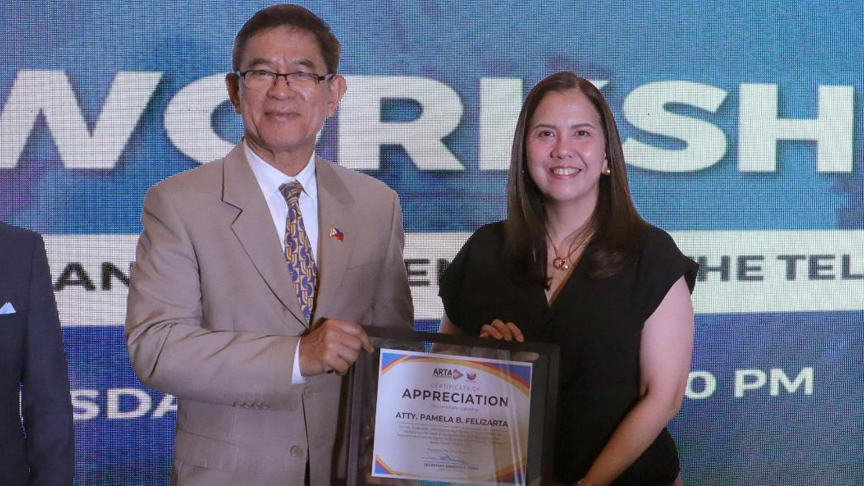
Atty. Pamela B. Felizarta, Head of Joint Strategic Operations at Smart, presented the permitting challenges still being faced by telcos, including those encountered while securing Mayor’s and Business Permits, unreasonable fees, and difficulties in obtaining consent from homeowners’ associations, among others.
“ARTA, together with other National Government Agencies and the private sector, have been working tirelessly to streamline the process of securing permits for the construction and installation of telco infrastructure. Our efforts have not gone to waste because these have led to the issuance of important circulars, guidelines, rules and regulations, and an executive issuance, which have paved the way for faster rollout of telco infrastructure across the nation,” Felizarta said.
“We continue to collaborate with local government units toward a full appreciation of EO 32, and we look forward to the enactment of local ordinances that adopt in full the IRR’s provisions,” Felizarta added. “Together with ARTA and our partners in the public and private sectors, we trust that we will continue to work closely together, since there is still so much work to be done.”
“ARTA in collaboration with the Department of Interior and Local Government (DILG) will draft a template ordinance for LGUs to adopt in order to expedite the approval process,” Perez added.
This collaboration supports the PLDT Group’s thrust to continuously expand and enhance its integrated fixed and wireless networks nationwide, in order to deliver leveled-up customer experience and power the country’s digital economy. The PLDT Group’s fiber footprint remains unparalleled and the most extensive in the Philippines, passing 18.13 million homes in 71% of the country’s towns and 91% of total provinces, while Smart’s combined 5G/4G network covers around 97% of the material population.
Since 2019, PLDT and Smart have been working closely with ARTA, government agencies such as the Department of Information and Communications Technology, National Telecommunications Commission, DILG, the Department of Human Settlements and Urban Development, LGUs and other industry stakeholders and telcos to streamline telco-related permitting processes.
This support is aligned with PLDT and Smart’s longstanding partnership with the Government as a whole to narrow the digital divide, bringing the benefits of the internet closer to more Filipinos across the country, and contributing to the United Nations Sustainable Development Goals (UNSDG), particularly on SDG 9 – Industry, Innovation, and Infrastructure.