




















































































During Christmas season, dispatching different goods and commodities from all over the world on time for a port is always important. At the end of last year, port congestion caused severe disruptions in global supply chains, and most stores were out of stock during the Black Friday and Christmas, the peak selling season.
To experience less dilemma like this, the innovation case from Tianjin Port might help.
Tianjin Port is one of the world’s largest ports. It has a 300000-ton-class wharf with a channel depth of -22 meters. It has 192 berths of various types and 128 berths above the 10,000-ton-class.
By the end of 2021, the port’s cargo throughput reached 435 million tons, ranking ninth in the world, while the container throughput exceeded 18.35 million TEUs, ranking the eighth port in the world.
The cost of manual operations at this scale is exuberant, both in terms of money and efficiency.
A typical port usually deals with vessel arrivals and departures, shoreside operations, horizontal transport, yard operations, manual tractor trailer transport, and gate operations.
One of the key steps in port digitalization is automating horizontal transport, that is, handling cargo within the port.
The Smart Port Solution uses the latest tech — intelligent twins, autonomous driving, 5G, cloud computing, and IoT — to create a better connected, smarter, and more autonomous system.
This smart terminal was built by Tianjin Port Group (TPG), together with Huawei and other partners, as part of its efforts to build a smart and green port.
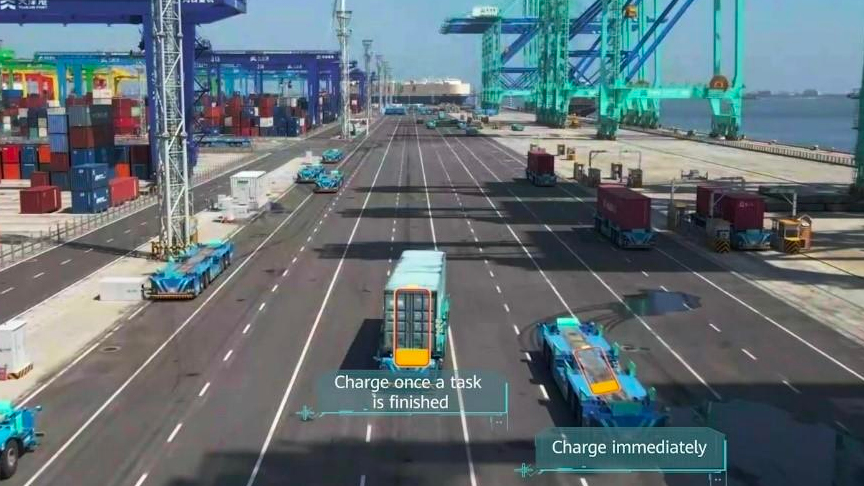
One of the key innovative applications to address this is Huawei’s self-developed, truly AI-based intelligent horizontal transportation system, which has achieved a series of “world firsts”: Large-scale commercial use of ultra-L4 driverless, the world’s first “5G+BeiDou” integration of ubiquitous intelligence, the world’s first self-sufficiency in green electricity and zero carbon emission, etc. This achievement provides a blueprint for other parts of the world to build intelligent and low-carbon ports.
The results speak for themselves. On the port’s visitor platform at the container terminal at Section C of Tianjin Port, container cranes operate automatically and unmanned electric container trucks come and go. At the port, remotely controlled quay cranes stably pick up containers that are loaded with cargo from cargo ships, and load these containers onto unmanned electric container trucks. Under the guidance of the BeiDou navigation satellite system, the container trucks go to the automatic locking/unlocking stations, according the optimal driving route calculated in real time, to unlock the containers, and then drive to the container yard. The whole process is completed in one go.
The intelligent and digital transformation of the port has led to tangible benefits. Previously, transporting containers to container yards within ports requires a large number of container trucks. Using human drivers is very costly. Tianjin Port currently has 76 container trucks. To ensure 24/7 operations, each container truck needs three drivers working in three shifts every day. The port needs 60% fewer staff than before.
In addition, it is exhausting for truck drivers to drive on fixed routes in three shifts, posing an obvious safety hazard. Now, Drivers (who are in high demand) now operate trucks remotely and no longer have to face dangerous, unhealthy working conditions. And each container now consumes 20% less energy, cranes are 20% more efficient on average, with each crane operating 39 container units per hour.
The terminal of Section C in the Beijiang Port Area of Tianjin Port is the first smart terminal of its kind to deploy an intelligent horizontal transport system. Looking ahead, Huawei will continue working with partners to deploy and replicate this experience in more ports, building smart ports together.

























