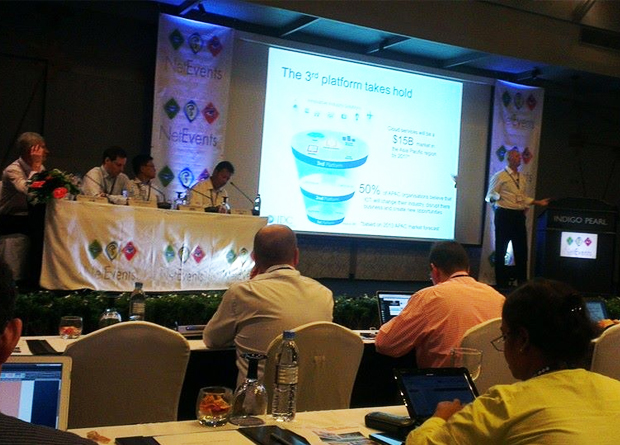
Adam Dodds of IDC noted that while 72% of APAC organizations believe in their cloud providers, there remain challenges for broader cloud usage to happen. In the Philippines, over 55% have less than or only equal to 10% budget allocation for cloud adaption. “This is a large opportunity for all,” Dodds said.
PHUKET, THAILAND – Key industry players are stressing the need to focus on open and hybrid cloud here at the NetEvents Asia-Pacific Press and SP Summit 2014. This is not only for service providers to start moving to ensure that cloud-related services are made readily available; but also for businesses to recognize that early cloud usage could prove to be beneficial to them.
As it is, cloud usage is already accelerating. According to interim results of the 2014 IDC Asia and the Pacific (APAC) survey, in 2013, 39% of Asia and Pacific (APAC) organizations were still not using cloud services. But in 2014, only 2% of organizations are not using cloud. In fact, as of now, 60% of APAC organizations are using two or more cloud services. In the Philippines, over 50% already use cloud.
“Cloud services will be a $15 billion market in APAC by 2017,” said Adam Dodds, IT services research manager of IDC.
CHANGING INDUSTRIES
According to Dodds, 50% of APAC organizations expressed their belief in the effects of ICT to change their industries. Interestingly, even as they believe that ICT will create new opportunities, they also similarly believe that ICT will disrupt their business. The challenge for companies, therefore, is on “how do I provide services, yet remain insightful (when running the business)? What does my business need to function, yet what does it need to have value?”
This is where the need for “an open cloud is needed,” said James Walker, vice president for managed network services of Tata Communications.
According to Walker, businesses have to respond to “more sophisticated customers wanting connectivity” as the “Internet is being used more and more.” “As data moves to the cloud, connectivity is becoming important again (to emphasize the) ‘network-centric cloud’,” he said.
Unfortunately, cloud market is still dominated by a small number of large players. Seventy-eight percent of global revenues are from only 23% of market players; and 83% of entrants generated less than $15 million in cloud revenues in 2012.
Walker nonetheless believes that “hybrid cloud will eventually become a dominant model.”
Hybrid cloud is when an enterprise uses both public cloud and virtualized resources with their own datacenter.
For Steve Chappell of Wedge Networks, the challenge is on “how to make customers use cloud without them knowing they’re using cloud,” he said. This is because there are businesses that are non-tech savvy, including small and medium businesses. Already, “we have businesspeople who have PDAs (personal digital assistant), iPad, use free Wi-Fi, and so on. This is the best opportunity for cloud providers to (tap) them,” Chappell said.
With an estimated 18 billion of devices already connected to the cloud, “a big part of business is already in cloud anyway, without them knowing that they’re using it,” Chappell said. The challenge is to make businesses see that they can have control over the security of “what goes in and out of their businesses without going too (techie). This resonates very well with customers.”
EARLY ADOPTION
Forrester predicts that 74% of enterprises will deploy hybrid by 2016.
Among those surveyed, early adopters expressed satisfaction with best-effort connectivity to cloud resources over public Internet links, Walker said.
Responding to the continuing growing industry, currently, there are already over 400 cloud service providers in the US alone.
Walker, nonetheless, said that there are challenges that need to be faced.
“As critical workloads are moved to the cloud, predictable performance, strong security and robust SLAs are needed,” he said. “Hybrid cloud needs predictable and secure network infrastructure. This is because the top concerns among enterprises adopting hybrid cloud remain security and the quality of services.”
Another need is the “standardization of interfaces to simplify integration and speed up innovation. A unified version in the industry will allow better service models to be built,” Walker said.
FACING CHALLENGES
Dodds agreed, saying: “Cloud is not without its challenges.”
Seventy-two percent of APAC organizations believe that their cloud provider has met or exceeded their expectations. In the Philippines, for one, less than 10% of cloud providers failed to meet expectations.
However, among APAC countries, the Philippines continues to be among the countries with the smallest number of organizations with more than 10% of budget allocation of IT spending towards cloud services. Also, just under 10% have no allocation at all for cloud services; and over 55% have less than or equal to 10% budget allocation for cloud.
“Cloud is becoming business as usual for APAC,” Dodds said. “It is a large opportunity for all.”
For Passakorn Hongsyok, department director for international business of UIH in Thailand, a key may be in simplifying the offerings. There is a need to focus on “how to make it simpler for businesses,” he said.
To deal with this, Kevin Buckingham, general manager of BT Compute, Asia, Middle East and Africa, BT Global Services, service providers need to look at “customer maturity” because “many are still unaware,” he said. He added, though, that “service providers need to work with their customers.”
For now, there is recognition that “it is time to change our focus – from the many exciting but diverse business opportunities being offered by today’s proprietary cloud offerings, to the need to evolve tomorrow’s cloud into an open environment offering limitless opportunities for all.”
“The industry has to come together,” Walker ended.