




















































































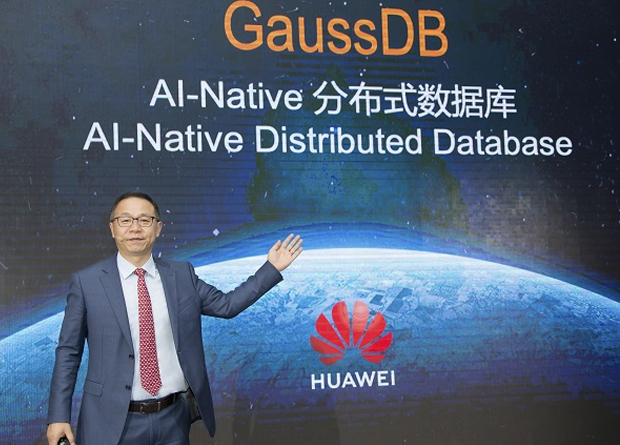
Following the announcement of its AI strategy and full-stack, all-scenario AI solutions in 2018, Huawei launched the AI-Native database GaussDB and the highest-performance distributed storage FusionStorage 8.0 today in Beijing. The aim of this launch is to redefine data infrastructure through a Data + Intelligence strategy.
“Humanity is entering the age of an intelligent world,” said David Wang, Huawei Executive Director of the Board and President of ICT Strategy & Marketing. “Data is the new factor of production, and intelligence the new productivity. Heterogeneous, intelligent, and converged databases will become the key data infrastructure of the financial, government, and telecoms industries.”
Committed to building a fully connected, intelligent world, Huawei is a major contributor to ICT infrastructure and smart devices. The leading ICT product and solutions provider continues to invest and innovate in AI computing power, algorithms, and labeled data with many breakthroughs. Mr. Wang added, “AI-Native database GaussDB will help enhance HUAWEI CLOUD’s capabilities and fully unleash the power of diversified computing, which includes x86, ARM, GPU, and NPU computing. We aim to continuously push our AI strategy forward and foster a complete computing ecosystem. Together with our partners, we will move further towards the intelligent world.”
GaussDB represents two major breakthroughs:
First, GaussDB pioneers the embedding of AI capabilities into the full lifecycle of distributed databases, making their self-O&M, self-tuning, self-diagnosis, and self-healing possible. In online analytical processing (OLAP), online transaction processing (OLTP), and hybrid transaction/analytical processing (HTAP) scenarios, GaussDB uses the optimality theory to create the industry’s first reinforcement learning self-tuning algorithm, improving tuning performance by over 60%.
Secondly, thanks to its innovative heterogeneous computing framework, GaussDB harnesses the power of diversified computing, including x86, ARM, GPU, and NPU computing. In the TPC-DS benchmark test, GaussDB ranked No.1 in terms of performance, 50% higher than the industry average.
GaussDB supports multiple deployment scenarios, including local deployment and deployment on private or public clouds. On HUAWEI CLOUD, GaussDB provides a full spectrum of high-performance data warehouse services for customers in financial, Internet, logistics, education, and automotive industries.
FusionStorage 8.0: The world’s highest-performance distributed storage
The intelligent world will raise standards even higher for the performance, scale, and manageability of storage systems. In response, FusionStorage 8.0 offers three innovative features:
First, FusionStorage 8.0 boasts the industry’s highest distributed storage performance. In the SPC-1 test, FusionStorage 8.0’s read-write performance per node reached 168,000 IOPS in 1ms, powering distributed storage for the first time to support critical enterprise applications.
Secondly, FusionStorage 8.0 simultaneously supports block, file, object, and Hadoop Distributed File System (HDFS) protocols, allowing a single storage system to manage an entire data center.
Thirdly, FusionStorage 8.0 integrates AI into full-lifecycle storage management, from resource planning and service provisioning, to system optimization, risk prediction, and fault location.
An industry ecosystem of openness, collaboration, and shared success
Huawei has redefined data infrastructure from computing, storage, and data processing. It leads diversified computing to make computing power more accessible and affordable. By redefining storage architecture, Huawei helps to increase storage efficiency and lead the way to intelligent storage. And a redefined data processing platform will make data analytics more intelligent and unleash the data of value faster.
So far, Huawei’s GaussDB and FusionInsight big data solutions have been deployed in 60 countries and regions, serving over 1,500 customers. These two solutions have been adopted by over 500 business partners, and are widely used in industries such as finance, telecoms, government, energy, healthcare, manufacturing, and transportation. HUAWEI CLOUD has launched 13 database services, including data warehouse services on the cloud for industry customers. Huawei FusionStorage was the market leader according to the IDC’s software-defined storage market share report in 2018.
Upholding the principles of openness, collaboration, and shared success, Huawei actively works with customers and partners to foster a database and storage industry ecosystem consisting of industry applications, platforms and tools, and standards organizations and communities.
To this end, Huawei has established long-term partnerships with independent software vendors, including iSSTech, DCITS, DHC Software, E-Hualu, Yonyou, and AsiaInfo, to pursue data applications in vertical industries. Huawei has conducted innovations in platforms and tools with partners such as Fanruan Software, ARM and Veritas. It is also an active contributor to standards organizations and communities, including OpenSDS, China Artificial Intelligence Industry Alliance, Open Compute Project, OpenStack, and Cloud Native Computing Foundation.
The Huawei Global Industry Vision (GIV) predicts that global data volume will increase from 32.5 ZB in 2018 to 180 ZB in 2025. Enterprise demand for AI computing power doubles every three months, and AI adoption will rise to 80% by 2025. Looking to the future intelligent world, Huawei will continue to invest and innovate, and work with partners to redefine data infrastructure. Together, they aim to build a complete ecosystem for diversified computing and make intelligent industries a reality.

























