The Joint Foreign Chambers of the Philippines (JFC) held the 6th Arangkada forum, themed “Implementing the 10-Point Agenda”. Co-sponsored by Eastern Communications, the 6th Arangkada Philippines Forum tackled the acceleration of the country’s economic growth using the administration’s 10-point Socioeconomic Agenda, which includes recommendations on key programs and policies in the fields of agribusiness, business processing management, infrastructure (telecommunications, water, transportation and power), manufacturing, logistics, mining and tourism.
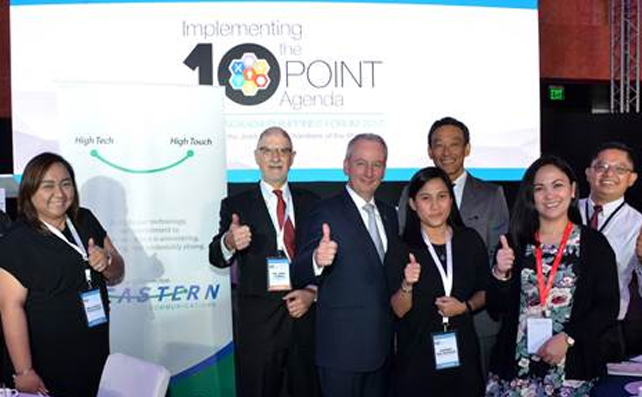
(From left) Mary Grace Villaruel, Eastern Communications Market Intelligence Specialist , John D. Forbes, Chief of Party, The Arangkada Philippines Project and Senior Adviser, The American Chamber of Commerce of the Philippines, Bruce Winton, President, American Chamber of Commerce of the Philippines, Jurelyn San Antonio, Eastern Communications, Campaign Management Coordinator, Hiroshi Shiraishi, President, Japanese Chamber of Commerce and Industry of the Philippines, Inc., Melanie Tabuena – Eastern Communications Product Management Specialist and Sidney Esteron, Eastern Communications Associate Account Manager
The 10-point Socioeconomic Agenda aims to spur self-sustaining and inclusive growth throughout the country, with its successful implementation depending not only on the efforts of the government but also the active participation of the business community. The fastest growing of the larger ASEAN-6 economies, Philippines’ economy has been seeing significant developments , with its gross domestic product (GDP) growth averaging 6.3 percent from 2011 to 2016.
However, National Competitiveness Council (NCC-private sector) Co-chair Guillermo M. Luz also pointed out the struggle to keep up with neighboring countries.
“In the report for global competitiveness or global competitiveness Index, we’re ranked 47th in 2015 but we slipped in the last year to 57th. This is a reminder that if we slow down (even) for a little bit, if we relax too much, other countries will move up,” Luz said.
To speed up the country’s economic growth, Department of Information and Communications Technology (DICT) Usec. Denis Vilorente stressed the importance of filling in the infrastructure gap. Among the projects needed are the proposed Mega Manila subway, construction and rehabilitation of airports and seaports, construction of 13 new bridges across Pasig River, and the rehabilitation of Guadalupe Bridge.
The modernization of the country’s telecommunication infrastructure is another challenge that needs to be addressed. As estimated by the World Bank, a country can achieve a 1.38-percent increase in its GDP if the broadband penetration is increased by 10 percent. Competitive digital connectivity can lower the cost of doing business while the digitization of processes and providing convenient online applications and licensing can cut down processing time and curb red tape, thus increasing the ease of doing business in the country.
DICT Undersecretary Dennis Vilorente said that they are now working on the reform of the public sector document processing through digital transactions and urging the local governments and agencies to make use of the GovCloud to reduce the paper filing for private firms and individuals.
The JFC recommends supporting start-up ventures to encourage the industry to move up the chain towards more technology and innovation driven ventures.
As one of the country’s telecommunications companies, Eastern Communications understands the role played by digital connectivity in spurring a country’s continued economic growth. Modernizing the country’s telecommunication infrastructure coupled with stronger start-up and SME support prompts a series of positive effects on the economy, such as bringing in investments, creating jobs, initiating innovations, and forming a progressive entrepreneurial industry.