




















































































Kaspersky Lab’s experts have studied the DDoS services available on the black market and determined just how far this illegal business has advanced, as well as the extent of its popularity and profitability. The worrying news is that arranging an attack costs as little as $7 an hour, while the targeted company can end up losing thousands, if not millions, of dollars.
The level of service involved when arranging a DDoS attack on the black market is not very different from that of a legal business. The only difference is that there’s no direct contact between the provider and the customer.

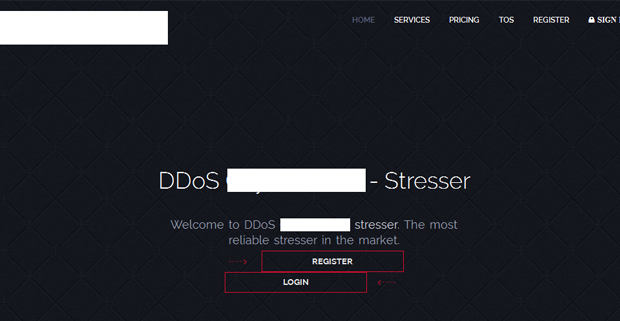
Example of a web service for ordering DDoS attacks that looks more like the web page of an IT startup than a cybercriminal operation
The ‘service providers’ offer a convenient site where customers, after registering, can select the service they need, pay for it, and receive a report about the attacks. In some cases there is even a customer loyalty program, with clients receiving rewards or bonus points for each attack.
There are a number of factors that affect the cost for the customer. One is the type of attack and its source: for example, a botnet made up of popular IoT devices is cheaper than a botnet of servers. However, not all those providing attack services are ready to specify such details.
Another factor is the duration of the attack (measured in seconds, hours and days), and the client’s location. DDoS attacks on English-language websites, for example, are usually more expensive than similar attacks on Russian-language sites.
Another big factor affecting the cost is the type of victim. Attacks on government websites and resources protected by dedicated anti-DDoS solutions are much more expensive, as the former are high risk, while the latter are more difficult to attack.
For instance, on one DDoS-as-a-service website, the cost of an attack on an unprotected website ranges from $50 to $100, while an attack on a protected site costs $400 or more.
It means a DDoS attack can cost anything from $5 for a 300-second attack, to $400 for 24 hours. The average price for an attack is around $25 per hour.

Various tariffs of an English-language service that varies its pricing according to the number of seconds a DDoS attack lasts
Kaspersky Lab’s experts were also able to calculate that an attack using a cloud-based botnet of 1000 desktops is likely to cost the providers about $7 per hour. That means the cybercriminals organizing DDoS attacks are making a profit of around $18 per hour.
There is, however, yet another scenario that offers greater profitability for cybercriminals – it involves the attackers demanding a ransom from a target in return for not launching a DDoS attack, or to call off an ongoing attack. The ransom can be the bitcoin equivalent of thousands of dollars, meaning the profitability of a single attack can exceed 95%. In fact, those carrying out the blackmail don’t even need to have the resources to launch an attack – sometimes the mere threat is enough.
“Cybercriminals are constantly on the lookout for new and cheaper ways of organizing botnets, as well as coming up with ever more ingenious attack scenarios that security solutions will have difficulty dealing with,” says Denis Makrushin, Security Researcher at Kaspersky Lab. “That’s why, as long as there are vulnerable servers, computers and IoT devices connected to the Internet, and many companies prefer not to invest in security against DDoS attacks, we can expect the profitability of DDoS attacks to continue growing, along with their complexity and frequency.”
Interestingly, some cybercriminals have no scruples about selling DDoS attacks alongside protection from them. Kaspersky Lab’s experts, however, do not recommend using criminal services.
























