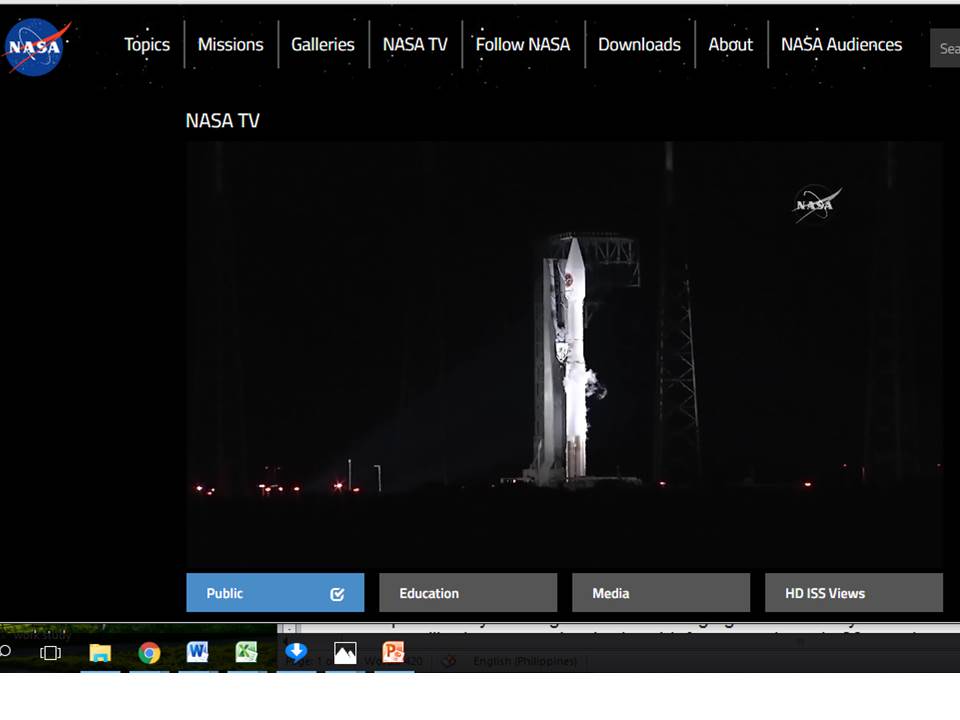
Following its historical delivery to the International Space Station (ISS) last month, Diwata-1, the first Philippine microsatellite, will be driven to space to start its mission on April 27, Wednesday, 7 PM (Philippine time). The space launch can be watched live at youtube.com/user/jaxachannel
According to the Department of Science and Technology- Philippine Council for Industry, Energy and Emerging Technology Research and Development (DOST-PCIEERD), the microsatellite will be released by the JEM Small Satellite Orbital Deployer at an altitude of 400 kilometers from the earth’s surface.
The deployment of Diwata-1 marks the first foray of a 50-kg class satellite from the Japanese Experiment Module (JEM) nicknamed “Kibo”, the National Research and Development Institute of Japan Aerospace Exploration Agency (JAXA) in Tsukuba Space Center said.
Acknowledging this historical milestone, JAXA noted that “the deployment of the microsatellite combines the only air lock and robot arm in the ISS used in Kibo operations, which, in the future, is expected to be one of the important means to meet the launch needs of microsatellites.”
Diwata-1’s mission is to capture photos and images from its main payload consisting of high precision telescope, spaceborne multispectral imager, and wide field camera. The telescope produces high resolution imaging for observing large-scale weather patterns while the imager is used for monitoring bodies of water and vegetation. Meanwhile, the camera is used in observing large-scale weather patterns.
According to DOST Secretary Mario G. Montejo, Diwata-1 is historic as it is designed, developed, and assembled by Filipino scientists. Aside from the microsatellite’s use in disaster-response mechanisms, agriculture, tourism, and others, it also marks a milestone in the country’s developing space program and a testament that local scientists can make our own microsatellite.
Meanwhile Philippine Ambassador to the United States Jose L. Cuisia, Jr. said that the launch of Diwata-1 is “not only a giant leap for Philippine science and technology. It could also provide Philippine policy makers with the scientific data and information needed to formulate policies relating to disaster mitigation, agricultural productivity, and management of land and water resources.
Diwata-1 is expected to be in orbit for approximately 20 months and will be imaging the country twice daily.
Along with the microsatellite development is the installation of the satellite ground receiving station called PEDRO or the Philippine Earth Data Resources Observation. Located in Subic, Zambales, PEDRO is tasked to receive DIiwata-1 imagery, including other images from selected commercial satellites.
Another space-related facility under construction is the UP Diliman Microsatellite Research and Instructional facility which will be the hub of training for future space technology research and development activities.
Diwatas 1 and 2, and the ground station called (PEDRO) are part of a three-year, P840.82-million microsat program. ( S&T Media Service)