Southeast Asia is fast becoming a major hub for Artificial Intelligence (AI) infrastructure.
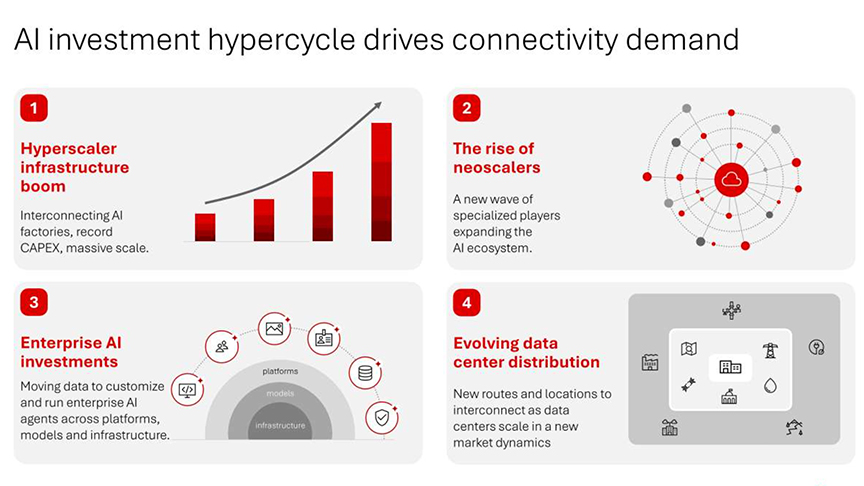
Telecommunications companies, data centers, and a new class of “neoscalers” are all investing in high-capacity connectivity to power the next wave of AI adoption across the region.
This development is fueled by AI’s growing need for faster, more distributed computing. Demand is rising for advanced optical networks, distributed computing systems, and stronger regional data center connections to support AI workloads.
According to Ciena’s Wave Services Report, the global revenue for high-capacity optical connectivity services is forecast to grow by 18% per year on average. Southeast Asia is outpacing that, with projected growth of 22% compound annual growth rate (CAGR). The increase is largely driven by demand for 100G, 200G, and 400G+ connectivity required to run large AI models and real-time applications.
An important factor in this expansion is the emergence of specialized neoscalers which offer GPU-as-a-service and AI infrastructure to complement traditional hyperscaler investments. Unlike traditional hyperscalers that build and run massive proprietary data centers, neoscalers use highly automated and scalable network services to deploy AI computing resources quickly and flexibly.
As AI shifts from large-scale model training to real-time inference, the need for low-latency computing closer to users is growing. Neoscalers are positioned to meet that need across Southeast Asia.
In fact, global investment in AI inference infrastructure is expected to overtake AI training investments in 2026. This shift will drive even more demand for geographically distributed computing facilities throughout the region.
The growth in AI workloads is also transforming Southeast Asia’s data center footprint.
Traditional hubs are hitting physical limits in Singapore, constraints around land availability and power supply are pushing investments into emerging market like Johor, Malaysia and Indonesia. These markets are seeing massive spikes in investment due to land availability and renewable energy access.
TM Global is responding by expanding its hyper-connected data centers in Klang Valley and Johor to support both AI training and real-time inference workloads.
The Philippines is also set to play a critical role as a subsea connectivity gateway, linking international traffic to regional AI infrastructure corridors.
To meet AI-driven demand, communication service providers (CSPs) are moving beyond standard fiber services toward automation-first, AI-ready infrastructure.
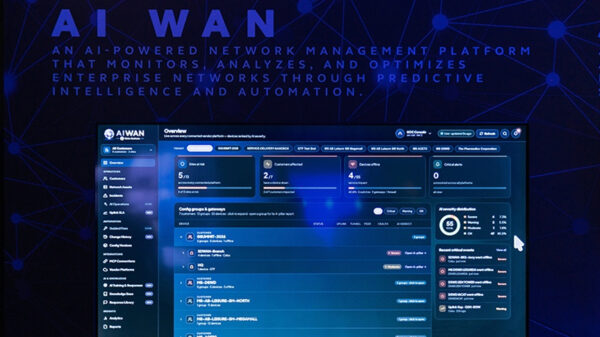
Key enablers of this shift include: Coherent 800 optics which is critical for moving massive datasets with maximum power and space efficiency; advanced network automation which is essential for the rapid “turn-up” and dynamic capacity shifts required by neoscalers; AI-powered network management which utilize AI to manage the network itself, enabling predictive maintenance and optimized performance; and low-latency network designs which simplifies network designs optimized for the massive parallel processing needs of GPUs.
CSPs are also scaling physical capacity. According to TM Global, standard cable deployments are moving from 96 fiber cores to 384 fiber cores to handle the growing bandwidth requirements of AI.