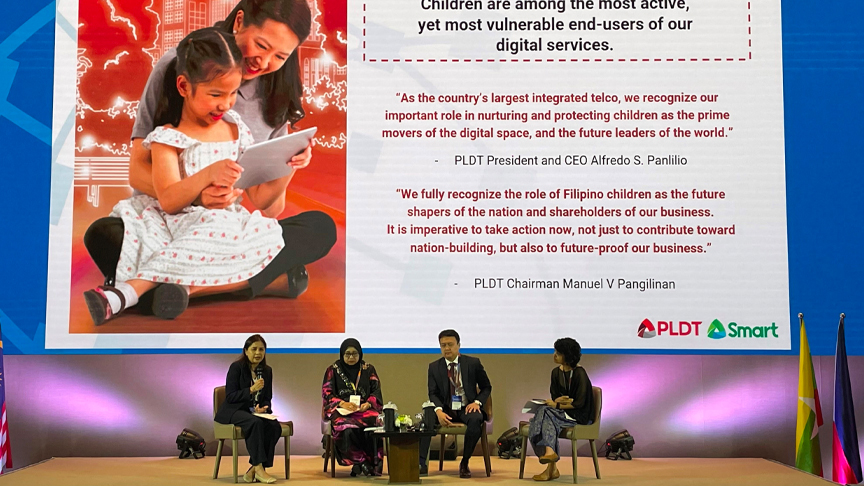
The Philippines’ leading integrated telecommunications network PLDT Inc. (PLDT) and its wireless unit Smart Communications, Inc. (Smart) participated as private sector representatives and highlighted the importance of harmonizing policies with technology during one of the panel sessions in the recent ASEAN ICT Forum on Child Online Protection held in Bangkok,Thailand.
Co-organized by Thailand’s Ministry of Digital Economy and Society, Ministry of Social Development and Human Security, ASEAN Commission on the Promotion and Protection of the Rights of Women and Children (ACWC), and supported by UNICEF’s East Asia and Pacific Regional Office, the forum aimed at strengthening regional cooperation on various aspects of child online protection, including the fight against online sexual abuse and exploitation of children (OSAEC) and child sexual abuse and exploitation materials (CSAEM).
The forum had more than 220 participants from various ASEAN countries and sectors, including representatives from the youth, government agencies, multi-lateral organizations, private sector, civil society organizations, and the academe. There were also delegates from China, Mongolia, Papua New Guinea, South Korean, Japan, Taiwan, the United Kingdom, Australia, Netherlands and France.
PLDT and Smart joined representatives from the Philippine Department of Justice (DOJ) and Malaysia’s Attorney General’s Chambers on a panel session about legislative reforms on child online protection. Given the recent enactment of Republic Act (RA) 11930 or the Anti-OSAEC and Anti-CSAEM Act and the release of its implementing rules and regulations, Philippine representatives were asked to present learnings on the legislative reform process.
PLDT and Smart shared earlier industry challenges under the old law, the RA 9775 or the Anti-Child Pornography Law of 2009, and talked about Philippine telco contributions to its amending legislation, RA 11930.
Under the old law, telcos, or Internet Service Providers (ISPs), had the sole responsibility of blocking and filtering sites with online child abuse. Local ISPs then raised concerns in implementation as compliance equated to violations of the Philippine constitution and data privacy laws.
“Telcos were hamstrung as to what we can do to comply, as there were conflicting and unconstitutional provisions in the old law. And because it was a 2009 law, there were also no considerations on the roles of online payment channels and social media networks. Insofar as the public was concerned at that time, telcos were the bad guys and were not doing enough,” explained PLDT and Smart’s First Vice President and Chief Sustainability Officer Melissa Vergel de Dios.
PLDT and Smart worked with the government, fellow industry players, and various sectors in seeking clarity on responsibilities and in amending legislation to address earlier concerns with the old law.
“The Philippine government was very collaborative and welcomed private sector inputs for the amendment of the law. We thus joined the industry in making our position known, offering technical inputs, and even rallying to harmonize several related bills in Congress. We also took our government partners to a tour of our cyber security facilities and provided a technical briefing on how we actually work to combat cyber threats and risks,” she said.
Among the notable enhancements from the old law, RA 11930 now provides clarity on responsibilities of ISPs and broadens participation of the private sector in the fight against OsSAEC and CSAEM.
“We realized that the landscape of private sector was much broader than just the telcos, so we included internet intermediaries, payment service providers, internet hotspots, and even hotels [in the new law],” said DOJ Undersecretary Atty. Nicholas Ty.
Recognizing the evolution of online risks and growing concerns on potential dangers of Artificial Intelligence, Vergel de Dios shared further insights in crafting effective legislation against OSAEC and other digitally enabled crimes.
“Lawmaking has to be as dynamic and as agile as technology. The understanding of technology drives the need to be able to see whether our laws stay adequate or whether they need to be updated,” she said.
During the forum, the ACWC also released guidelines for ASEAN member countries on harmonized and comprehensive national legislation against all forms of online child sexual exploitation and abuse.
“We are proud of the development of RA 11930 as it very well aligns with the ASEAN guidelines, embodies adoption of an inclusive and adaptive legislative view of the digital ecosystem that enables online child abuse, as well as fosters active engagement of private sector and various entities in anti-OSAEC policymaking, response and prevention, among others,” expressed Ty.
Fulfilling their institutional commitment towards protecting children online and complying with RA 11930, PLDT and Smart have been integrating children’s rights into their operations and sustainability roadmap, implementing a Child Safeguarding Policy, and utilizing a Child Protection Platform solution that blocks online content and access attempts linked to OSAEC and CSAEM without violating privacy laws.
The telcos have also expressed continuing commitment towards capacity-building, global benchmarking, and pursuing multi-sectoral collaborations to remain abreast with solutions to protect children online and combat OSAEC and CSAEM.