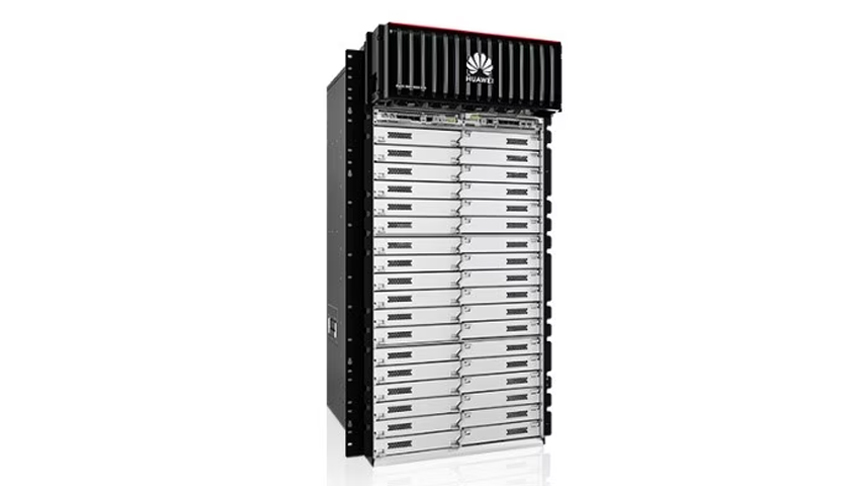
Huawei launched the industry’s first next-generation OTN — Kepler platform oriented to Data Center scenarios.
As we transition from the Internet era to the digital era, cloud and computing services are becoming ubiquitous. As a result, consumers and enterprises are raising their experience expectations. Against this backdrop, new applications are emerging and higher requirements are being imposed on network devices in terms of capacity, energy consumption, and agile operations and maintenance.
Huawei’s Kepler platform supports a single-subrack switching capacity of over 100 by using a new cross-connect architecture. Compared to the current OTN platforms in the industry, Kepler uses innovative heat dissipation technology to reduce the per-Gbit power consumption by 65%, supporting deployment of DC equipment rooms whose power usage effectiveness (PUE) is less than 1.2. It also uses the intelligent computing kernel to improve the autonomous driving capabilities of the system.
The Kepler platform is innovative for three different reasons:
First, it redefines the cross-connect architecture of OTN platforms.
On a conventional OTN platform, service boards and cross-connect boards are connected through a backplane bus, and this results in long links and large losses. The Kepler platform, however, innovatively uses rear-mounted cross-connect boards, with service boards and cross-connect boards directly connected through holes on the backplane. This greatly reduces link losses of boards. On this platform, Huawei has deployed the industry’s first dual 3D orthogonal architecture. It supports flexible deployment of service boards, doubles the number of slots, and achieves ultra-high-speed SerDes links. The single-subrack capacity can reach 100T. This is four times higher than the industry average, so the orthogonal architecture can easily cope with the traffic surges of the digital era.
Second, it redefines the heat dissipation mode of OTN platforms.
In the optical communication field, Huawei first introduced the front-to-rear airflow design concept for energy-efficient DC equipment rooms. With innovative heat dissipation technologies such as intelligent Hato fans and thermal-conductive materials, the Kepler platform greatly improves the heat dissipation capability of boards while reducing the power consumption, thereby achieving green data center construction.
Third, it uses customized computing units based on optical systems.
The Kepler platform innovatively uses built-in high-precision optical sensors and optical computing units (OPUs). It can detect optical parameters in milliseconds. This is nearly 1000 times faster than the industry average. As a result, the Kepler platform can support the precise construction of digital optical networks and ensure that the network is always in optimal working condition.
Continuous breakthroughs in optical transmission networks and continuous evolution in optical technologies are required to efficiently transmit massive amounts of data and allocate diverse computing resources across cloud networks on demand. Huawei’s Kepler platform can provide strong support for operators to cope with the explosion of traffic, reduce costs and improve efficiency, facilitate the development of new services, and promote sustainable prosperity in the digital economy.