Urbanization continues to profoundly shift the face of Philippine towns and cities. With the lack of ample crop production areas and more people migrating from rural to urban zones, primary availability and access to food are severely impacted. In fact, over 3.9 million Filipino families continue to experience involuntary hunger due to food inaccessibility.
Epson has always held a strong commitment to sustainability and protecting the environment, not only in its products but also in its initiatives that enrich communities. More recently, the company has shifted more focus to enabling the circular economy through upcycling and breathing second life to used materials. To spur its commitment into action, Epson continually partners with like-minded organizations such as World Wide Fund for Nature (WWF) Philippines to further its eco-initiatives and contributions to a greener future.
Strengthening Epson’s sustainability initiatives through urban gardening
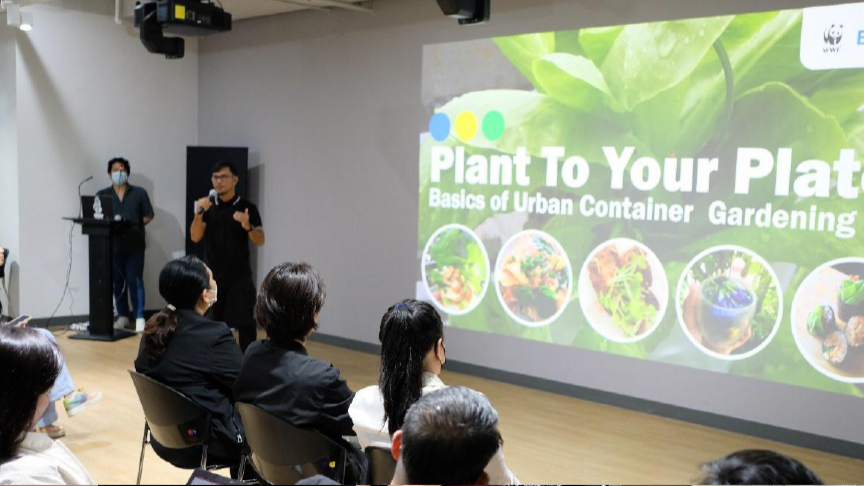
Earlier this year, Epson partnered with WWF-Philippines to conduct an urban gardening workshop for the global technology leader’s employees. Facilitated by WWF-Philippines Sustainable Food Systems Project Manager Monci Hinay, the workshop aimed to educate attendees on the practice, and showcase how people in urban spaces can benefit from urban gardening and sustainable food systems.
Throughout the workshop, Epson employees learned about what urban gardening entails, such as what kind of crops work best depending on the time of the year. Participants learned in-depth tips and the basic steps of urban gardening: starting from site selection, seed sowing and seedling care, container selection, transplanting, water fertilizer, and pest control. Participants also learned how to kickstart their gardening journey: from concocting their own natural pest control to utilizing companion planting.
Understanding the basics of urban gardening
According to WWF-Philippines, the practice of urban gardening addresses one of the key pillars of food security, access to food, as well as the growing issue of household waste management. The method involves growing produce in portable and modular planters, in areas where agricultural spaces are not typically available, such as cities and urban centers. Urban gardening enables the cultivation of crops in compact areas and vertical structures, akin to hydroponic technology at a more affordable cost.
Additionally, urban gardening combats another growing problem: single-use plastics and plastic pollution. The practice gives life to potential waste products such as old plastic bottles, conveniently turning them into miniature planters that can fit in any space.
“What we’re doing right now is part and parcel of the solution because as we speak, a lot of our fellow Filipinos are experiencing hunger and malnutrition,” said Hinay. “We hope more people start to practice urban gardening and pass these methods forward so that we, as a community, can begin to address these growing issues surrounding food and food security.”
The urban gardening workshop, while highly informative and engaging, is just the first step in addressing the food crisis from an individual level. Epson, together with WWF-Philippines, hopes to roll out more eco-initiatives to educate and inspire individuals to practice the method and embrace their roles as stewards of sustainability.
“Our efforts and eco-initiatives represent our simple contribution to Epson’s global environmental goal of becoming a pioneering company that employs its effective, compact, and precise technologies to achieve a sustainable future,” said Masako Kusama, President and Director of Epson Philippines. “We are glad for our growing partnership with WWF-Philippines, and all the opportunities that will help put our commitment to sustainability into practice.”