Microsoft held its AI for Accessibility Hackathon, an Asia Pacific-wide competition where participants developed prototypes of artificial intelligence (AI) solutions to transform the daily lives of people with disabilities (PWD), in the Philippines.
400 teams of students and young developers in the Asia Pacific worked side-by-side with startups and nonprofit organizations to simultaneously conceptualize AI solutions that address the lack of awareness and availability of assistive technology in the region.
Seven countries (Korea, Indonesia, Malaysia, Singapore, Thailand, Vietnam and the Philippines) were assigned to address specific issues identified by local partners serving PWDs. Philippine teams were challenged to formulate solutions to upgrade the daily life, employability and communication of the visually impaired.
Filipino developers were asked to focus on enabling secure online and offline payment experiences, enhancing wearable daily life technology, improving storytelling and public speaking skills, and increasing the accessibility of websites through AI.
“In Microsoft, we hope to empower every individual to achieve more, regardless of how they communicate, see, hear or move. With the help of our homegrown developers, we hope to not only bring betterment to the daily lives of the visually impaired, but to also enable a shift in the creation of an inclusive environment full of opportunities for people with disabilities,” said Andres Ortola, general manager of Microsoft Philippines.
“With tremendous technological advancements in the region, particularly with AI and its significance in the immediate term, more can be done to both improve the access to and increase the viability of assistive technology for the visually impaired.”
In 2017, the Department of Health reported over 2 million cases of blindness or poor vision. Health experts have identified visual impairment as a cause of reduced functional ability and quality of life, and a perpetuator of economic repercussions as it depletes the productivity and income of those who suffer from it.
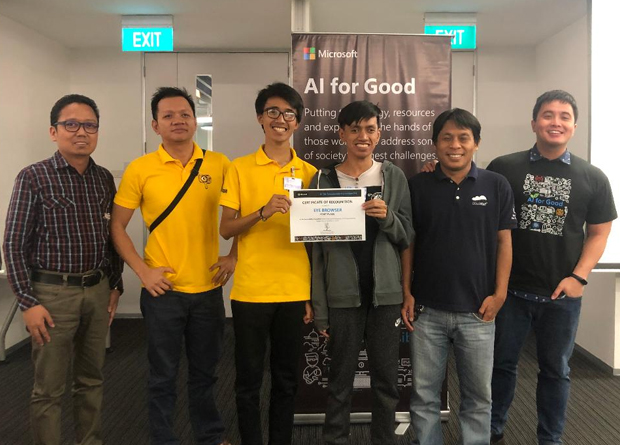
Leading the country’s list of victors is the team of SpeedyOnyx Philippines Inc., Cloudstaff Philippines Inc., and Atriev, which created Eye Browser, a formatted browser that has voice communication, quick keys and streamlined buttons built into specific websites to ease Internet navigation for the blind.
The team of Asia Institute of Management and Atriev bagged the second place as they created Paylight, an app that helps the visually impaired to easily identify what peso value they are holding through image recognition.
In third place is the NTT Data and Atriev team, which conceptualized Aeye, a wearable pair of glasses that enables the blind to improve their presentation skills by using machine learning, and cognitive services to assess the emotion in a room during public events.
The above prototypes, as well as the winning entries from each market, are eligible to apply for Microsoft’s AI for Accessibility grants, to bring their ideas one step closer to reality.
Microsoft strengthens their dedication to champion PWDs through a systematic approach that has inclusion in its core: hiring people with disabilities, creating inclusive marketing and communications, and upholding the standards to which they hold their partners and vendors.