







































































“Fake news” is one of the buzz phrases of 2017. First coined during the US presidential election last year, the term has taken on a life of its own and is now part of common parlance for many broadcasters, commentators and consumers alike.

New research by YouGov reveals that the majority of APAC residents do believe that “fake news” is a problem. However, it also shows that what the problem is exactly is far harder to define.
TV is the most trusted source of news content
The study found that consumers view TV as the most trusted source for news, with three quarters of those polled (75%) placing either a little or a lot of trust in TV. This is followed by radio (trusted by 70%) and newspapers (68%), while digital is the least trusted source for news (60%).
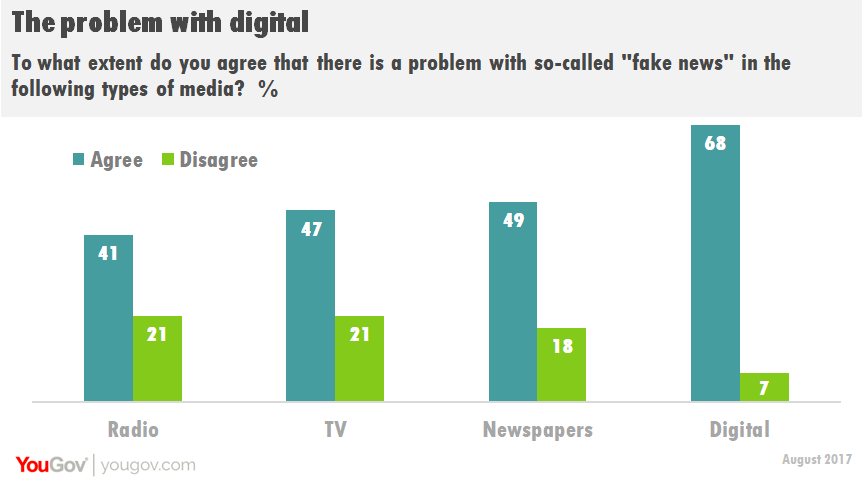
Yet consumers also accept that these sources can be responsible for spreading “fake news”. Despite reporting high levels of trust in TV, nearly half (47%) of respondents believe there is a problem with fake news on TV. A similar number report concerns over “fake news” in newspaper content (49%) and radio (41%). However, concern about “fake news” surges to more than two-thirds (68%) of respondents when it comes to digital content.
Just one in eight people place “a lot” of trust in news that friends and family share online
Social media is a key site for news content, with more than a third of APAC residents (37%) sharing online news content on social media at least once a day. This is even higher in Thailand (54%), Vietnam (50%), Indonesia (44%) and the Philippines (40%).
While the majority of respondents (58%) say they trust news that friends and family share on social media, just 13% of those polled place “a lot” of trust in news that friends and family share online. Australians are the least trusting, with 7% of people not placing any trust in content that their friends and family share. This is more than double the regional average of 3%.
Over half of APAC respondent think more negatively of a brand that was found to be advertising on a platform that contains fake news
Consumers are cautious over the content they see online and more than half (56%) have conducted independent research to check the validity of a news story. Yet despite recognising the problem of “fake news”, consumers can be unaccepting when brands become tied up with the issue; a majority of respondents (54%) would think more negatively of a brand that was found to be advertising on a platform that contains fake news. Furthermore, two thirds of APAC residents (66%) would trust a brand less if it was found to be advertising on a platform that contains fake news.
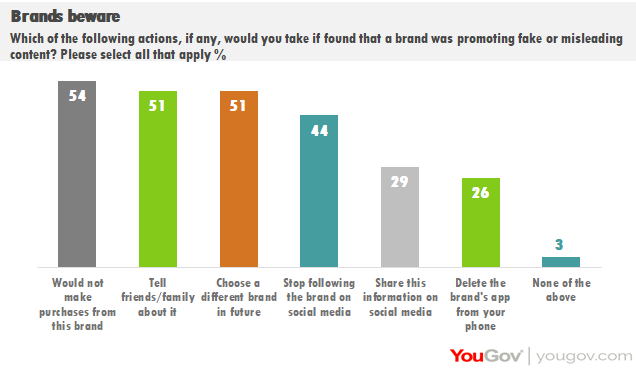
54% of respondents would no longer make purchases from a brand found to be promoting fake or misleading content
The survey also shows how brand scandals are able to influence consumer behaviour, as well as opinion. For instance, if consumers were to find out that a brand had been promoting fake or misleading content, a majority of consumers would no longer make purchases from this brand (54%), choose a different brand in future (51%) or tell family and/or friends about it (51%). Furthermore, three in ten consumers (29%) would share this information on social media and a quarter of consumers (26%) would delete the brand’s app from their phone.