Almost six in ten (58 percent) smartphones sold in Q2 2015 were 4G-enabled, according to the latest global smartphone sales data from GfK. And with a major operator launching 4G services in India at the start of this month, 4G is now available in all key countries. GfK forecasts 4G smartphone penetration to continue to grow at the expense of 3G, which is currently at 38 percent of smartphone units and is forecast to decline by another percentage point by Q4 2015.
Kevin Walsh, director of trends and forecasting at GfK, said: “India is expected to be the largest contributor of absolute smartphone unit growth globally this year. The main reason behind this is the currently low smartphone penetration in the market together with a significant intensification of the competition amongst the smartphone vendors, which will drive ASP erosion allowing more affordable devices in the market.”
There are significant regional differences in 4G take up: price polarization in N. America, saturation in W. European markets, local brands tackling global players in India and China, and intense price competition in emerging markets.
Walsh continued: “The first half of the year has seen macro events providing headwinds to topline demand in regions like C&E. Europe, LATAM and China. However, the underlying trend of consumers optimizing their digital consumption by screen size, within affordability constraints, continues in all regions. This trend can be seen from TV’s down to smartphones. In smartphones, it manifests in trends like price point polarization in the US, the rapid screen-size increases in emerging markets and phablet market development. These trends are forecast to continue to the end of year but we see new inflection points and market drivers for 2016.”
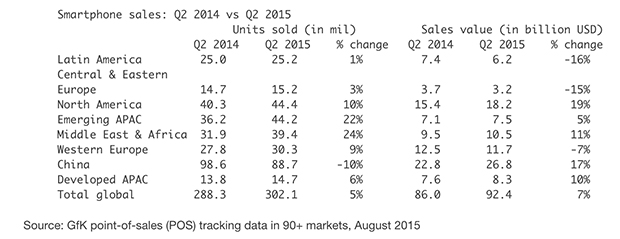
Here’s how the global smartphone market stands today:
In North America, which like W. Europe is nearing saturation point, we see a price polarization as sales of high ($500+) and low end ($0-250) devices grew at the expense of mid-ranged devices ($250-500). Smartphones in the high end captured 43 percent of smartphone unit share in Q2 2015, up from 38 percent in 2Q 2014. N. America and China were the only regions to see an increase in high-end smartphone unit share on a year-on-year basis.
Unit sales of smartphones grew +9 percent year-on-year in Q2 2015 in Western Europe, but sales value declined, due to a mix shift towards the low-end observed in the quarter capturing almost 50 percent of the smartphone unit mix, up from 37 percent in Q2 2014. This region had very high LTE penetration levels in smartphones in Q2 2015, with the Nordics taking the top three places: Norway at 90 percent, Denmark at 89 percent and Sweden at 88 percent.
Unit sales fell -10 percent year-on-year in China to Q2 2015, which follows the previous quarter’s decline of -14 percent year-on-year. However, strong demand for high-end smartphones ($500+) pushed smartphone value up +17 percent year-on-year to $26.8bn in the quarter. The high-end smartphone market now accounts for 17 percent of the market, up from 10 percent in Q2 2014 – and is growing at the expense of the low-end. In 2015, GfK forecasts high-end unit demand in China to grow +28 percent year-on-year, the strongest growth in this price band of any region this year.
Despite unit sale declines of -11 percent year-on-year in Russia and -34 percent year-on-year in Ukraine driven by macroeconomic factors, the total regional smartphone demand grew +3 percent year-on-year in Q2 2015, buoyed by strong growth in Poland andRomania. GfK forecasts smartphone unit demand in Russia to decline to -14 percent year-on-year, and -23 percent year-on-year inUkraine in 2015.
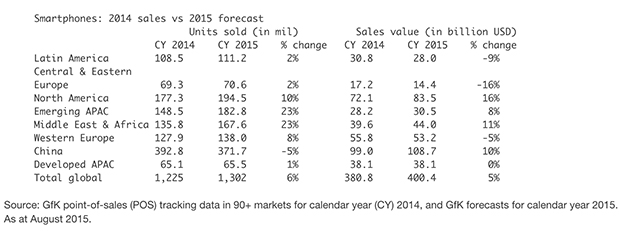
A significant slowing of growth in this region has been caused mainly by the macroeconomic situation in Brazil. Q2 2015 saw +1 percent year-on-year unit growth, compared to +28 percent in Q1 2015 and +72 percent rise in Q2 2014. In 2015, GfK forecasts total smartphone unit demand and sales value to drop in Brazil for the first time ever, with unit sales expected to fall -3 percent year-on-year, and sales value to decline -15 percent year-on-year.
In Emerging APAC, smartphone unit demand increased by +22 percent year-on-year in Q2 2015, with all major countries growing. Indiain particular has seen strong unit growth of +40 percent year-on-year, with local brands accounting for three of the top five smartphone vendor spots in the quarter. A number of Chinese smartphone brands have entered the Indian market this year, intensifying the already fierce competition between international and local vendors. The resulting price war is forcing ASPs down in a market where more than 80 percent of sales are in the low-end. In Q2 2015, smartphone ASP in India declined -12 percent year-on-year. In 2015, GfK forecasts smartphone prices in India to fall -11 percent year-on-year and 4G unit demand to more-than-triple, capturing 6 percent of the smartphone unit demand.
Unit sales in Developed APAC grew +6 percent year-on-year in Q2 2015, driven by Japan (+15 percent), which benefitted from an easy comparison with low sales in Q2 2014. GfK forecasts smartphone unit demand in the region to grow by +1 percent year-on-year in 2015. A -6 percent smartphone demand decline in S. Korea will be offset by Japan, which is forecast to see a +3 percent year-on-year increase.
“Weak macroeconomic trends will continue across a number of major countries such as Brazil, Russia and China, but recoveries when they come are often faster than expected especially for tech sectors. In addition, we are still a long way from saturation in emerging market while adjacent industries to the smartphone fuel the next round of growth, generally complementing and in some cases cannibalizing smartphone growth,” Walsh ended.