The U.S.’s fast-rising demand for software talent is creating shortages and demand-supply imbalances for specific skill sets for countless companies across almost all sectors, according to a new report by The Boston Consulting Group (BCG).
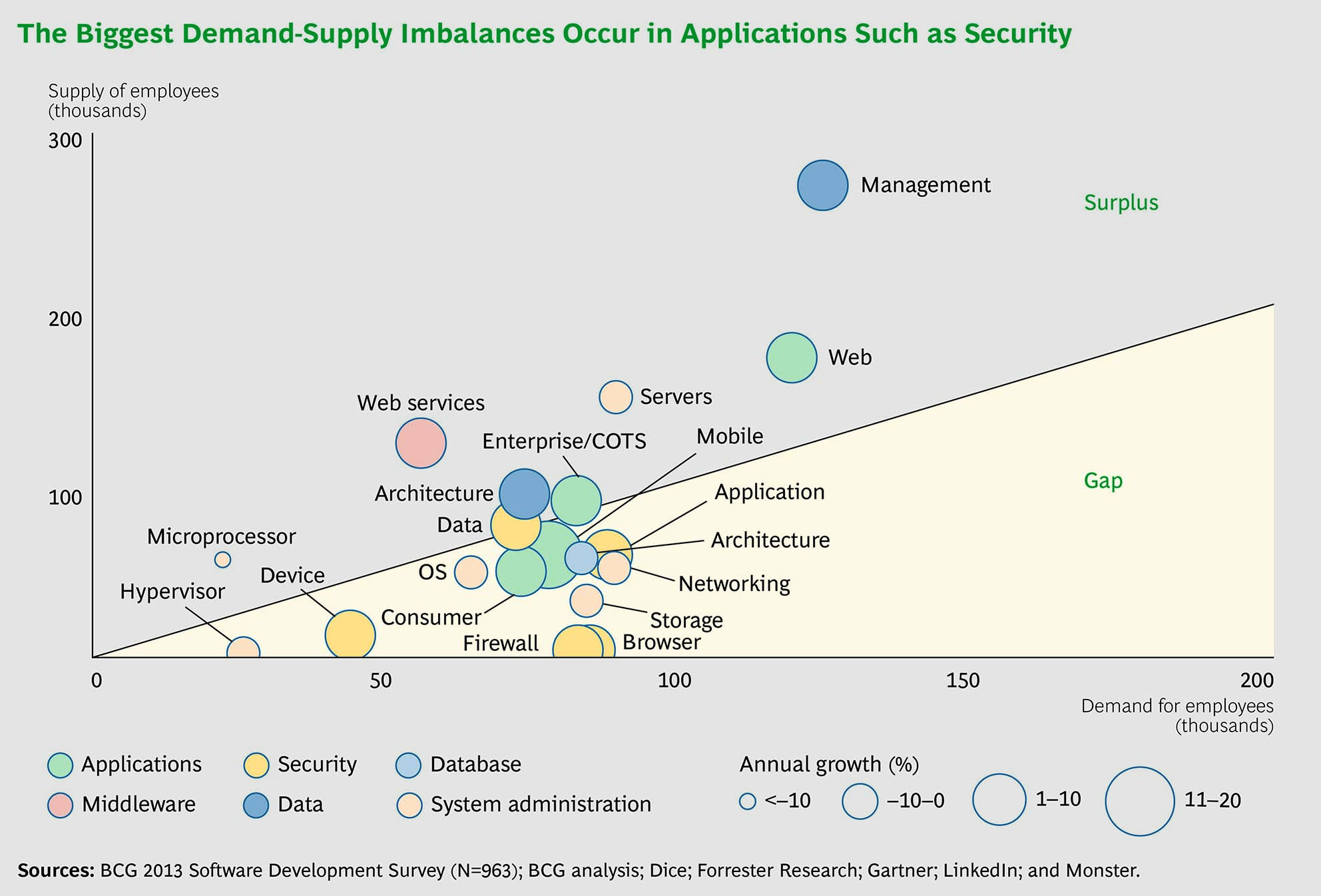
The largest shortfalls, in terms of types of applications, are in security, enterprise applications, and systems-networking and storage engineers. The security field presents an especially daunting challenge: some 200,000 software security positions in the U.S. are currently unfilled. Meanwhile, there is a surplus of nearly 200,000 employees working with software architecture in the data and database layers and in data management.
Within security, there is a particularly high shortage of experts in network security (Web and enterprise firewall, for example). The shortages are driven by several trends, including the rapid growth in the popularity of cloud computing and mobile connectivity, the emerging practice of bringing your own device to the workplace, and the rising popularity of Agile software development.
“These trends present companies, especially those in nontech industries that nevertheless need tech talent, with multiple challenges,” says Guy Gilliland, a BCG senior partner and a coauthor of the report. “If such companies cannot attract and retain the software expertise they need with current recruiting and retention efforts—and many cannot—they risk falling behind in technological capability and product development.”
The proliferation of software languages and frameworks adds substantially to the demand-supply complexity. Hundreds of software languages and frameworks are in use today, and they continue to multiply as new software technologies are developed to meet more specialized needs. Some languages, such as FORTRAN and COBOL, have been around for decades and are still in widespread use. Others are only a few years old but power some of the most prolific applications in use today.
Many developers can work in multiple languages and frameworks: BCG research shows that on average, software developers know six languages at an “intermediate” or “above skill” level and three at an “expert” level. The demand for such talent in multiple areas keeps growing faster than the supply. Approximately half the software developers today view skills in three areas as the most important: SQL, Java, and JavaScript. Another third include skills in .NET, C++, and Oracle as well. SQL, HTML, C++, and C# skills are in oversupply; the largest talent shortages are in C, Objective-C, JQuery, and Visual Basic. Another 25 or so languages are also still widely used.
“Fast-rising demand is one problem, but from a management standpoint, the issue is far more complex,” says Raj Varadarajan, a BCG senior partner and a coauthor. “Companies also face the challenge of determining the skills they need for their strategy and product development. They need to build the capability, if they have not already done so, to translate corporate and product strategies into resource plans, specifically with respect to software talent.”
Overall, there were more than 1 million software developers employed in the United States in 2012, according to BLS. Demand for software developers outpaced supply by some 35,000 positions and is expected to grow at more than 20 percent per year through 2022—a sixfold increase.