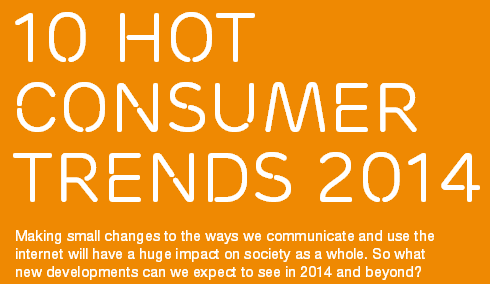
With 2013 coming to an end, Ericsson ConsumerLab has identified the hottest consumer trends for 2014 and beyond.
“The most important trend we see is the mass demand for apps and services across all industries and societal sectors – which has the potential to fundamentally change everyday life,” Michael Björn, Head of Research at ConsumerLab.
Apps change society. The fast global uptake of smartphones has completely changed the way we communicate and use the internet. Now we enter a new phase of rapidly-diversifying smartphone use – and people are looking for apps across all sectors of society. This includes everything from shopping and daycare to communication with authorities, and transportation. Apps are becoming more important than what phone you use.
Your body is the new password. Sites are demanding longer passwords with a mixture of numbers, letters and symbols – almost impossible to remember. This is leading to growing interest in biometric alternatives. For example, our research found that 52 percent of smartphone users want to use their fingerprints instead of passwords and 48 percent are interested in using eye-recognition to unlock their screen. A total of 74 percent believe that biometric smartphones will become mainstream during 2014.
The quantified self. Blood pressure, pulse and steps are just some examples of how we want to measure ourselves with mobile devices, using personally-generated data. You only need to start an app to track your activities and get to know yourself better. A total of 40 percent of smartphone users want their phone to log all of their physical activities and 56 percent would like to monitor their blood pressure and pulse using a ring.
Internet expected everywhere. Internet experience has been falling behind voice; smartphone users are realizing that the signal bars on their phone no longer provide reliable guidance, since a signal that is adequate for a voice call may not be good enough for internet services. Our research found that the lowest satisfaction is with the internet quality experienced on the subway.
Smartphones reduce the digital divide. Internet access on a global scale is still inadequately and unequally distributed, giving rise to what is referred to as the digital divide. The advent of cheaper smartphones means that consumers no longer need costly computing devices to access internet services. A total of 51 percent of consumers globally feel that their mobile phone is the most important piece of technology – and for many it is becoming the primary device for internet use. The increase of cheaper smartphones is providing more consumers with the opportunity to participate online. In India, Indonesia and Philippines, the smartphone is now the primary internet device
Online benefits outweigh concerns. As the internet becomes an integrated part of our daily lives, the risks associated with being connected are becoming more apparent. 56 percent of daily internet users are concerned about privacy issues. However, only 4 percent say that they would actually use the internet less. Instead, consumers apply strategies to minimize risk such as being more cautious about the type of personal information they provide.
Video on command. Despite having greater media choice, we seem less prone to choose what we watch ourselves. In fact, our friends are particularly influential when it comes to viewing video material. We found that 38 percent of respondents say they watch video clips recommended by their friends at least several times weekly. Our friends have almost as much impact on our blog-reading and music-listening habits too.
Making my data visible. A total of 48 percent of consumers use apps to better understand their data consumption. While 41 percent just want to know how much data they use, 33 percent want to make sure they are billed correctly and 31 percent don’t want to exceed their operator’s data cap. Research also revealed that 37 percent of smartphone owners regularly use apps to test their connection speed.
Sensors in everyday places. As interactive internet services are now commonplace, consumers are increasingly expecting our physical surroundings to be equally responsive. By the end of 2016, around 60 percent of smartphone owners believe that sensors will be used in everything from healthcare and public transport, to cars, homes and our places of work.
Play, pause, resume elsewhere. As 19 percent of total streamed time is spent on phones or tablets, consumers are increasingly shifting the locations where they watch TV to suit their daily lives. For example they might start viewing content at home, pause it, and resume watching during their commute to work. When changing places, it can also make sense to switch device.