

























































With the iPad Air, Apple Inc. not only has trimmed the weight and thickness of its flagship tablet line, it has also cut the component cost, as the new model carries a lower bill of materials (BOM) than the third-generation iPad introduced last year.
The iPad Air with 16 gigabytes (GB) of NAND flash memory and cellular connectivity has a BOM of $304, according to preliminary results from the Teardown Analysis Service at IHS Inc. This represents a 6 percent reduction from $325 for an equivalently equipped third-generation iPad, based on a final pricing estimate for the device at the time of the release in 2012.
When the $6 manufacturing cost of the iPad Air is added in, the total cost to make the tablet increases to $310.
For the lowest-end iPad Air model with 16GB of NAND and no cellular connection, the BOM and manufacturing cost is $274, $42 less than the entry-level third-generation iPad.
“While the iPad Air slims down in size, the profit margins are getting fatter,” said Andrew Rassweiler, senior director, cost benchmarking services for IHS. “Although the Air’s new, ultrathin display and touch screen are more expensive than for the third-generation iPad, Apple has held the line on cost by taking advantage of price erosion in other areas. Furthermore, the iPad Air leverages the same components and suppliers that are used in the iPhone 5s and 5c as much as possible.”
The profitability of the iPad Air rises dramatically as the NAND memory capacity increases. For example, the 32GB model costs Apple only $8.40 more to produce—but has a retail price that’s $100 higher.
 iPad slims down on display diet
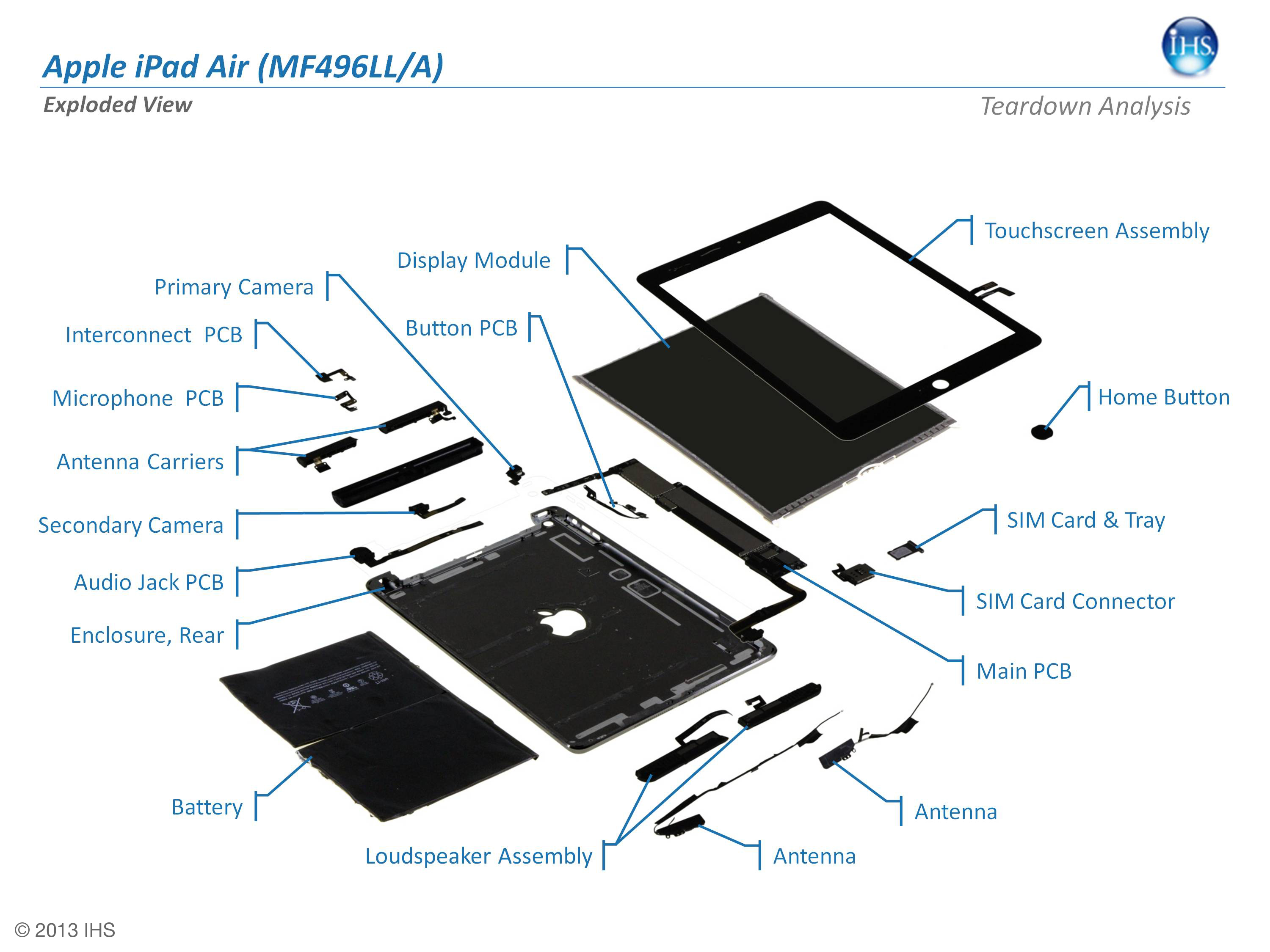
The iPad Air’s thinner form factor is partly due to reductions in the thickness of the display and touch-screen subsystems.
The Air’s display is 1.8 millimeters (mm) thick, compared to about 2.23 mm for the older-generation iPad. Meanwhile the touch screen is also thinner with its use of an expensive cyclo olephin polymer (COP) film sensor vs. the thicker and cheaper glass sensor used in the previous models.
However, such svelteness comes at a price, with both subsystems more costly than before.
The iPad Air’s display carries a cost of $90, compared to $87 for the third-generation model. The touch-screen module is estimated at $43.00, compared to $37.50 for the third-generation iPad.
Used chips
The iPad Air uses the same Apple-designed, Samsung-manufactured A7 processor found in the iPhone 5s, with some variations.
The Air’s A7 integrated circuit is packaged with a metal top that acts as a heat sink. The A7 likely runs hotter in the iPad Air than in the iPhone 5s because of the additional processor workload required to render graphics on the larger display.
In another variance, the power management chips from Dialog Semiconductor that support both versions of the A7 are tangibly different. IHS will conduct a further examination of the A7 to determine if there are other differences between the processors.
The Air also uses the same memory to support the A7 processor as the 5s, employing 1GB of low-power Double Data Rate 3 (LPDDR3) DRAM.
Moreover, similar to the 5s for the core baseband and RF transceiver functions, the Air employs the same suite of chips: the MDM9615, WTR1605L and PM8018 from Qualcomm Inc.
Chip changes
In contrast to the processor and baseband segments, the RF/power amplifier (PA) modules in the iPad Air are different compared to the iPhone 5s, in a way that makes a big difference to Apple.
The RF/PA section in the iPad Air supports the 4G Long Term Evolution bands for all U.S. carriers with a single-model iPad (there are not different wireless versions for each U.S. carrier). This isn’t the case for the iPhone 5s, probably due to space constraints in the smaller smartphone form factor.
Also, the RF/PA subsystem in the iPad Air is laid out on 40 percent more surface area in the printed circuit board than the comparable function in the iPhone 5s.
Electricity is in the Air
Interestingly, Apple has reduced the capacity of the battery in the iPad Air compared to the previous iPad. Battery capacity in the iPad Air is 32.9 watt hours (Wh), down 23 percent from 42.5Wh in the third-generation model.
This is most likely because of lower power consumption in the display backlight. The iPad Air uses only 36 light-emitting diodes (LED) to illuminate the liquid-crystal display (LCD), down from 84 in the earlier-generation iPad. Fewer LEDs results in lower electricity demand, allowing the cut in battery power.
Big changes for microphones
The newest iPad sports major differences in the microphones.
The Air uses digital microphone technology rather than the analog parts in the third-generation model. Apple has exclusively utilized analog microphones in all its smartphones and tablets—except for the iPad 2, which sported a digital microelectromechanical system (MEMS) microphone from Analog Devices Inc.
In another major departure, Apple is employing two microphones in the Air, as opposed to one in the previous models. The second microphone likely performs noise cancellation.
Finally, the iPad Air uses microphones from STMicroelectronics, instead of the parts from Knowles and AAC found in the other iPad models.