In recent years, millions of people around the world experience the lack of affordable and nutritious food. In the Philippines, close to 3.9 million Filipino families continue to experience involuntary hunger and around 40 percent of all Filipinos are considered food poor.
To address these growing challenges, global technology leader Epson has partnered with World Wide Fund for Nature (WWF) Philippines to help improve the resilience of food systems and rebuild livelihoods of local communities. Together with WWF Philippines, Epson has recently built a Food Shed Farming System in Tarlac City.
“The system utilizes a food shed model that acts as a modular greenhouse made of locally available materials and uses green and natural farming technologies such as composting, rainwater harvesting, natural pest and disease control,” said WWF Philippines project manager Monci Hinay. “It is an agriculture-based livelihood intervention that promotes sustainable production, integrates the elements of low-impact urban agriculture technologies, and provide communities with food security while operating within planetary boundaries and protecting habitats and biodiversity.”
Ensuring food security and sustainable livelihood for all
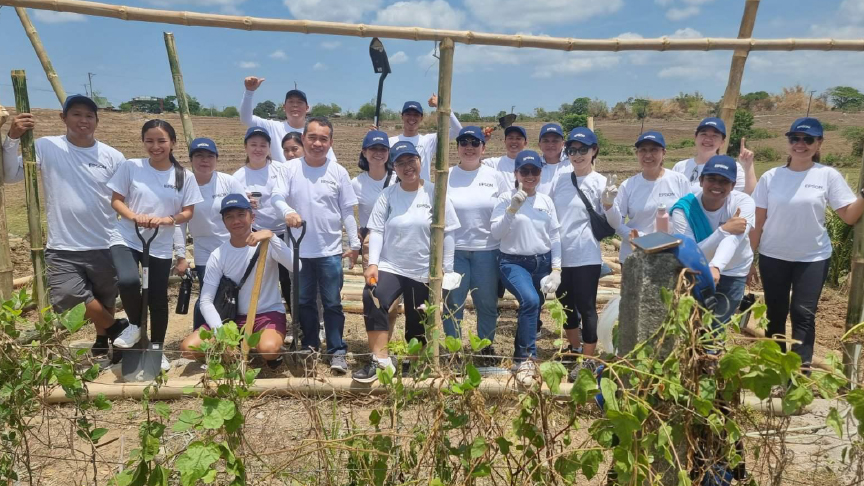
Epson volunteers, together with WWF Philippines representatives, local government officials, and representatives from the City Agruculturist Office, participated in the construction of the food shed in San Jose de Urquico, Tarlac. The food shed will directly provide livelihood opportunities to caretakers, who will manage the overall production of high-quality vegetables and poultry products, and facilitate linkage to local community buyers of the produce and livestock products. During the groundbreaking, Epson volunteers worked on plotting and seed preparation, mulching and holing, and the actual construction of the food shed.
Epson’s second food shed is located in Sapang Tagalog, Tarlac. With these two locations, Epson and WWF Philippines aim to train community members in food production, value chain, and business development; improve access to high-quality and locally produced food for households in San Jose de Urquico and Sapang Tagalog; and improve the resilience of low-income communities to stresses brought by the pandemic and climate change.
“In line with our commitment to enriching communities and enabling them to achieve sustainability, we are excited to begin this journey of sustainability and resiliency with WWF Philippines and our community in Tarlac,” said Masako Kusama, president and director of Epson Philippines. “We believe this climate-adaptive food shed farming technology is key to building resilience among communities who do not have direct access to food sources like farmland or municipal fishing grounds and can ultimately protect them against hunger and disruptions in food supply.”
Enabling capacity development in food shed farming
The project includes technology transfer sessions for partner communities in Tarlac to help them manage their food sheds. Members of the community will learn on sustainable food production, value chain development plan formulation, and financial literacy and savings mobilization. Continuous learning activities will be executed to enhance the skill sets of the community members in successfully growing the crops and producing the livestock products.
Establishing a community-managed food shed
To promote bayanihan or community work, the community-managed food shed showcases the multiple benefits of compact and protective farming and urban agricultural production. The establishment of the food shed will also provide an avenue for the community to work together towards a common goal of addressing food security and livelihood.