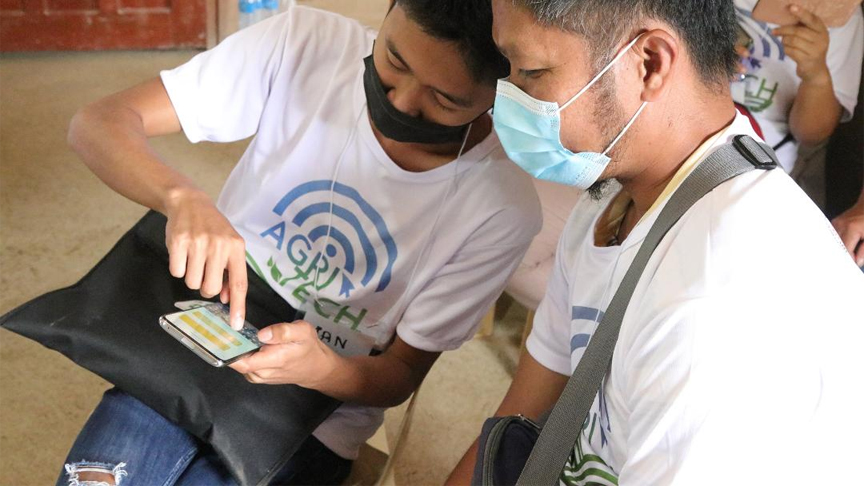
Datu Federico W. Sia, an elder of the Ovu Manuvu indigenous cultural community in the mountain barangay of Ilomavis in Kidapawan City, North Cotabato has been struggling to sell his farm produce ever since the city was hit by a series of destructive earthquakes in 2019. The difficulty continues to this day as Covid-19 health and safety protocols restrict public mobility.
On any given day, Datu Sia personally travels to the downtown area of Kidapawan City to bring his harvest to the public market. Though there is no assurance of his goods being completely sold, it is the only way he knows to market his produce. That is until he joined one of the trainings under the Digital Farmers Program (DFP) conducted by the Department of Agriculture – Agricultural Training Institute (ATI) in partnership with Smart Communications, Inc.
Held last August 25, the DFP 101 training was participated in by 30 trainees including the 63-year old farmer of coffee, cassava, and other root crops. Datu Sia shared that he found the program enriching for traditional farmers like him.
“Sauna, motan-aw ra ko sa akong mga apo kung magkuri-kuri sila og smartphone kay keypad ra man akoa pero karon murag nadasig nako, kung makakwarta ko basin mopalit ko ani kay pwede diay picture-ran na lang nako akong mga produkto unya ipost na lang nako basin daghan pay makapalit kay mas daghan daw makakita, para pud naa koy sure buyer na [I would just watch my grandchildren play and explore their smartphones before but now, I’m interested in exploring and maximizing their features myself. I would buy one if my budget allows it. It will be useful. I can take photos of my farm products then post them online to reach out to more possible buyers],” the father of three said.
During training, Datu Sia was partnered with a young Manuvu who is adept at smartphones and internet.
Digital Farmers Program
The Digital Farmers Program (DFP) is a three-course sequence program focusing on acquainting, capacitating, and empowering smallholder farmers with basic digital tools and technologies, particularly the basics of smartphone use, internet and social media, internet safety, social media marketing, mobile agriculture, online transactions, digital entrepreneurship, and financial literacy.
The program also taps tech-savvy youth in actively onboarding smallholder farmers into the digital space, and consequently, establishing a solid channel of idea-exchange from using modern agricultural technologies to discovering old-age farming traditions passed down through generations.
“When we talk about agriculture, it now expands to the digital space. With Smart, we do not just bring communication services to the community, we also want to make it relevant to their livelihood,” said Stephanie Orlino, Smart Community Relations AVP and Head. “By educating farmers through DFP, we aim to help make technology work for our farmers so they can eventually reap the benefits of digitally-enabled farming,” Orlino added.
“Our teams are trained to teach these courses in a manner that is tailored to our farmers,” said ATI 12 Director, Abdul I. Daya-an.
Daya-an also commended Smart’s continuous support to DA-ATI in the rollout of DFP which benefits present and future farmers especially those in the underserved communities in Central Mindanao.
“This kind of partnership is worth celebrating. We are glad that we have teamed up with Smart in realizing our goal and promoting our advocacy to reach more communities,” he said.
Elvie Joy B. Arab, one of the beneficiaries of the program, is grateful she was able to attend the training saying the knowledge gained from the lectures and activities will help her run her family’s businesses.
“The training-workshop is very useful and helpful especially now that most of us are online. I will apply the learnings to our family’s small business ventures. Apart from managing a small farm, we also make and sell hollow blocks. I think social media marketing will help our businesses grow,” she explained in local language.
The young Manuvu is looking forward to the next course which is scheduled to be conducted before the year ends.
To help his fellow farmers in the community, Datu Sia said he will ask the assistance of the youth in their barangay to cascade the learnings from DFP101 and conduct bi-monthly meetings to teach those who were not able to attend the training and to also refresh the knowledge of the older group that completed the course.
ATI Region 12 Information Officer Hannadi Pompong hopes that the same people who attended the DFP101 course will also attend the subsequent DFP 102 and 103 workshops so the participants can learn more advanced tools and applications as they integrate digital innovations into their activities.
The Digital Farmers Program and ‘Buy Local’ initiative reside under Smart’s framework of Technology for Development that aims to narrow down the digital divide.
PLDT and Smart leverage on digital technologies to improve the lives and livelihood of its communities such as farmers and fisherfolk, Indigenous Cultural Communities, and MSMEs and usher them into the digital economy.
The programs are also aligned with the commitment of PLDT and Smart to support the 17 Sustainable Development Goals (SDGs) of the United Nations, particularly No Poverty (SDG 1), Zero Hunger (SDG 2), and Decent Work and Economic Growth (SDG 8).